Showing posts with label Enigma Rosso. Show all posts

1.06.2016

[GIALLO SOURCE CODE] Twin Peaks, Enigma Rosso, and Private Crimes


[NOTE: Some NSFW screencaps below. And, as with every post on this site, SPOILERS SHOULD BE EXPECTED.]


The “wrapped in plastic” discovery of doomed Laura Palmer—the enigma-eyed force that drives David Lynch’s TWIN PEAKS—has become a part of the tapestry of the TV mystery. Esp. in relation to the tradition of “weird mysteries,” which find their origins in the pulp work of writers from the early 20th century. The same early-20th-century pulp writers who were being translated by Mondadori for Italian audiences, creating a phenomenon of popular reading that would eventually help usher in the cinematic success of the Giallo. 

Charting both this varied history, and these mutating strains, of the Giallo—its enduring iconography, to borrow Lee Howard’s phrase—has been the job of this SOURCE CODE series.
 

Not only have I charted the passage of its imagery from the Krimi to the Giallo (here and here, for example), I’ve also charted the various visual “quotations” that’ve occurred within the confines of the Italian genre itself—e.g., the way that Carlo Vanzina’s 1985 Giallo NOTHING UNDERNEATH takes Helga Ulmann’s death-by-window from Argento’s DEEP RED and reworks it for its own ends … *and* the way that that same shot actually predates Argento’s film, first appearing in the climax of Sergio Pastore’s 1972 Giallo THE CRIMES OF THE BLACK CAT (screencap comparisons here).
 

For this installment, I’ve gone outside the Giallo genre, to those iconic visuals wrapped up with the discovery of Laura’s body. In order to flag up a key mystery-thriller image that was both prefigured by the Giallo, and was later reabsorbed back into it (as the influence of US television helped rewrite the work being done on Italian small screens in the 1990s).


So: 1978’s ENIGMA ROSSO. That last entry in the “Schoolgirls in Peril” trilogy, a trilogy that engages with (some would say: wallows in) any number of the taboo and ugly scenarios surrounding the “secret life of schoolgirls”. Similar to the investigation into Laura’s hidden life in PEAKS, the trilogy spools out shocking and stomach-churning details about the secrets these well-to-do students are living. ENIGMA ROSSO posits an environment where Catholic schoolgirls—when not engaged in their studies—are engaged in dark and violent orgies with faceless, well-connected men in their community. The quite graphic flashbacks in ROSSO esp., perhaps more than any other entry in the trilogy, foreground just how disturbing these encounters are—indeed, forces the idea that these students aren’t just sexually active, but sexually active in the most dangerous and self-destructive of ways.
 

And, interestingly enough, ENIGMA ROSSO opens with one of those schoolgirls—whose involvement in state-sponsored orgies is hitherto unknown by her community—being found dead, wrapped in plastic, near water.


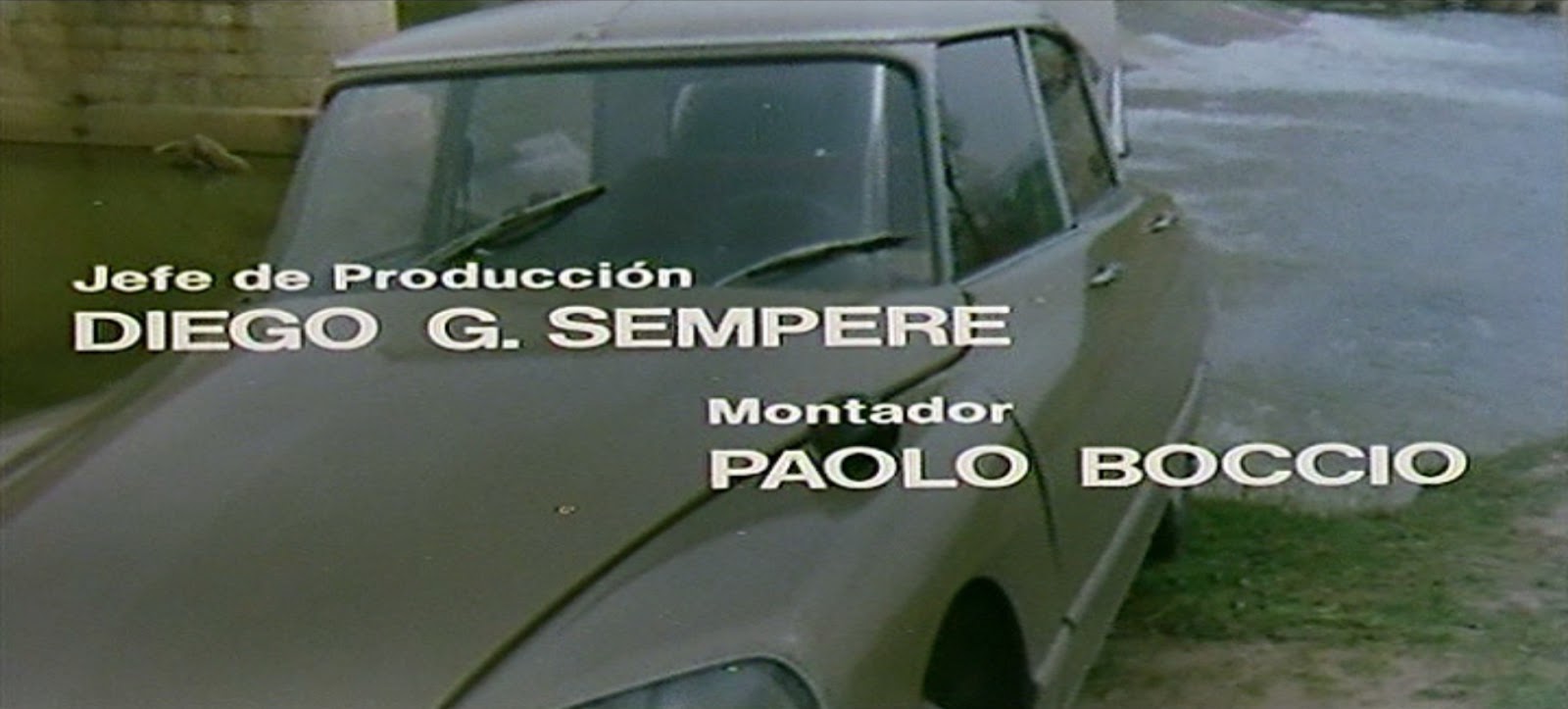
The opening credits play over a crawl of the camera that moves from rushing water to the body of the dead girl (a crawl that’s very similar to the one done across Palmer’s body in PEAKS). This crawl also includes detail shots of two vehicles—presumably driven by the killers—and the sudden plunging of the plastic-wrapped body, from off a cliff where the vehicles are parked, into the rushing water below.


There’s also a curious shot, after the girl’s wrapped body is dumped in the water: The camera, now underwater, presumably somehow representing the dead girl’s p.o.v., looks back up at the cliff from where she’s just been thrown and shows us a brief glimpse of her murderers as they drive away (one in a car, the other on motorcycle).


Once the body is discovered, we get more of the camera tracking along the (now exposed) body of the victim.


Post-TWIN PEAKS, it’s impossible to watch these scenes and not think of the discovery of Palmer’s body. I’m not trying to make a case that Lynch or Frost watched ENIGMA ROSSO while writing their pilot, but the narrative and visual synchronicities speak to the kind of intertextual pleasures that’re to be had, while watching yourself deep and wide into the Giallo genre—there is so much depth, so much richness of overlap, that the web of associations feels like it never ends. 

That overlap also sometimes expresses itself in the form of attempted cash-ins. Many Italian genres are shot through with very obvious examples of producers seeing and trying to mimic the global success of other films: the way, for instance, that the success of THE FRENCH CONNECTION and DIRTY HARRY shaped, re-shaped, deformed the development of the Eurocrime (Poliziottesco).

In this case, we have Giallo great Sergio Martino directing a four-part Italian TV miniseries in 1993 called PRIVATE CRIMES (aka, DELITTI PRIVATI). The story centers around the disappearance and death of a promising student in a local community. The young woman is, on her surface, a kind of ideal member of that community—incredibly talented, well-liked, hard-working. 

So, when her body is found, abandoned, near a river, the community reels not only from her death, but from the ensuing series of revelations about her “secret” life: She had potentially seamy connections to a local nightclub, to drugs, and, worse, was sleeping with a married (and much older) industrialist whose corrupt money had helped sustain the town (a fact that the locals mostly resent). 


As I’ve written elsewhere, the miniseries plays out like a much less-weird, less-compelling version of the TWIN PEAKS mystery, with a series of recognized and much-beloved genre faces—Edwige Fenech (who co-produced), Ray Lovelock, Gabriele Ferzetti, Alida Valli, Paolo Malco—populating the landscape of this secret-ravaged town.
 

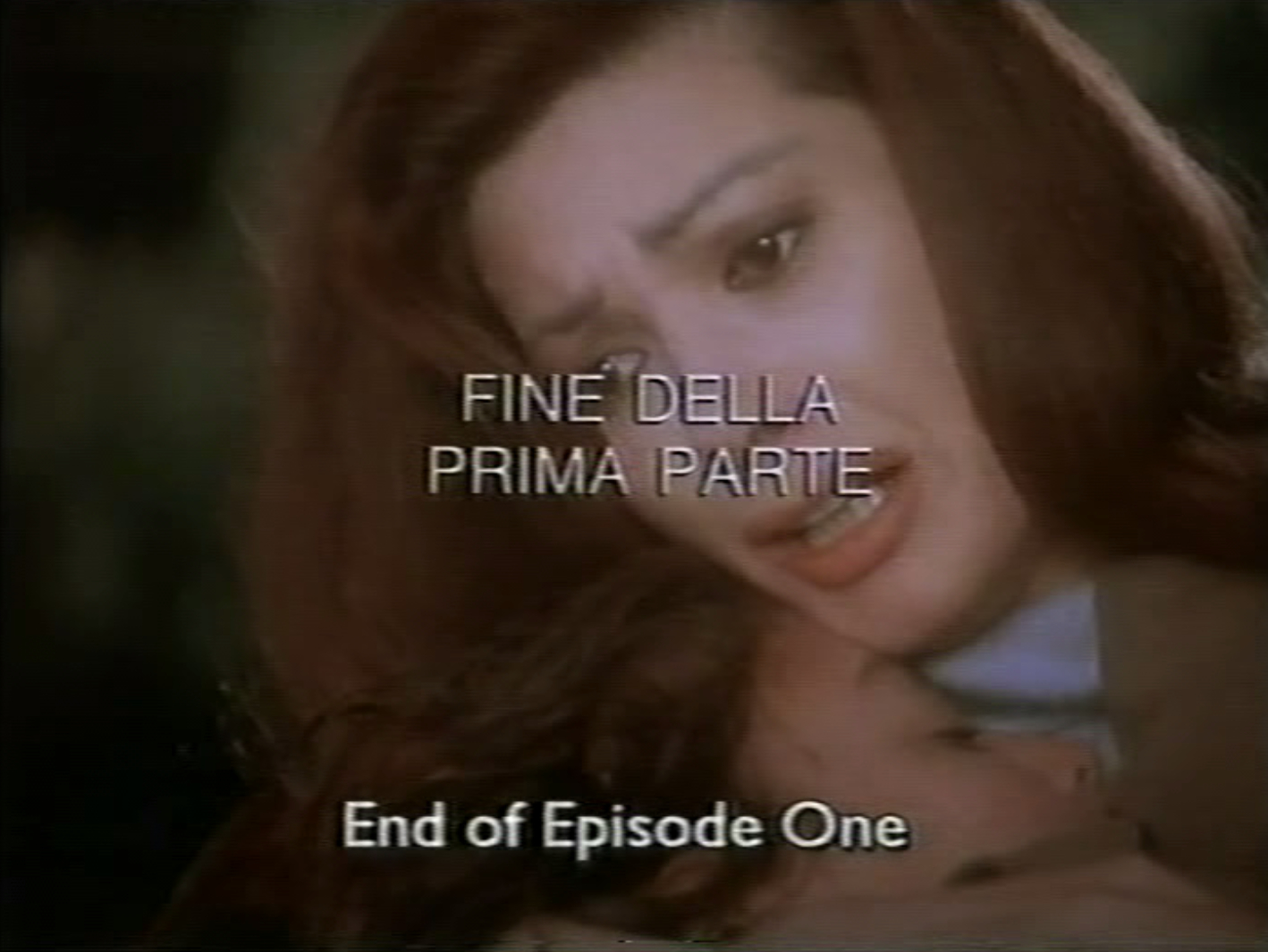
Fenech plays the murdered girl’s mother and is the one who discovers the body. And though the staging here lacks most of the visual cues from PEAKS, its general melancholy and mood—coupled with the plot points and musical cues borrowed from Lynch’s series—certainly reinforce the link. And the notion that the iconography of the Giallo never goes away exactly, it just gets reborn.


Leonard Jacobs
January, 2016


12.27.2015

GIALLO SOURCE CODE [SOLANGE, ENIGMA ROSSO, and Kim Newman]


In my last review, I touched on the “Schoolgirls in Peril” sub-genre that’s become so well known to fans of the Giallo. Though some identify only the three key titles as comprising the sub-genre—the loosely linked trilogy of WHAT HAVE YOU DONE TO SOLANGE? (1972), WHAT HAVE THEY DONE TO YOUR DAUGHTERS? (1974), and ENIGMA ROSSO (aka, RINGS OF FEAR [1978])—there are a number of other films that qualify, including the Poliziotteschi/Giallo hybrid WITHOUT TRACE (aka, CALLING ALL POLICE CARS [1975]), which picks up the schoolgirl prostitution ring of DAUGHTERS and does an equally disturbing variation on the theme.

The other angle that’s interesting, in the context of this site, is the Krimi connection—i.e., how the ingrained Krimi-ism of the ingĂ©nue-in-distress plot is made more extreme in the guise of sexualized schoolgirls and the consequences they face because of their promiscuity. And how the Giallo SOLANGE was recut, retitled, and resold as a Krimi in Germany.


On the audio commentary for Arrow Video’s recent Blu-ray release of SOLANGE, Kim Newman touches on these points:

“I think the real reason this is set in London is not to do with the Italian side of it, but to do with the German side of it. In Germany this isn’t a Giallo called WHAT HAVE YOU DONE TO SOLANGE?, it’s a Krimi, called THE SECRET OF THE GREEN STICK PIN … one of the last entries in a very long series of 1960s grotesque crime movies based on the works of the British author, Edgar Wallace. This is notionally based on a book of his called THE CLUE OF THE NEW PIN … those movies [the Krimis] were all set in London and mostly starred the star of this movie, Joachim Fuchsberger, playing the man from Scotland Yard …”
Though Neman sees a distinction between the Krimi and Giallo in the *degree* to which they’ll push their sexuality and violence, he sees SOLANGE as a kind of quintessential example of that dual genre citizenship held by so many Krimi/Giallo Hybrids from this era:
“… although sort of seamier and rougher than those movies [Krimis], [SOLANGE is] very much in their tradition. There are imperiled schoolgirls, there’s a crime in the past that has to be solved, there’s a series of baffling crimes, and Scotland Yard—in the person of Joachim Fuchsberger—and an innocent personage who is suspected of the crime—in the person of Fabio Testi—have to investigate, independently, to come to a solution. That’s the template for the Krimi.”
His conversation with Alan Jones also covers the tendency, especially in British films of the day, for schoolgirl thrillers “where the likes of Suzy Kendall or Jenny Agutter are wearing short skirts and being stalked”. Newman then goes on to relate a fascinating “true” story that is the supposed source for all of these films:
“It all dates back to a tabloid story, from the early 1960s, which may or may not be true—it’s probably newspaper nonsense. Which was that, in a particular school, girls who were sexually active would form a kind of secret society that they would signify by wearing … the little badges that came with Robertson’s Jam, which were Golliwogs, stylized representations of black minstrels. This was a huge thing throughout the 60s and 70s and is now kind of culturally suppressed and forgotten.
“Even when Robert Hartford-Davis, one of Britain’s few exploitation filmmakers, made a film in the early 60s about this phenomena—it was called THE YELLOW TEDDY BEARS—it replaced the Golliwog badges with Teddy Bear badges. In this movie [SOLANGE], it’s the green pins that the girls in the secret society wear … that signify their involvement in sordid, sexual activity.”
And, in the “Schoolgirls Trilogy”-proper, we see this theme taken up again. In ENIGMA ROSSO—the final entry, meant for Massimo Dallamano but directed by Alberto Negrin after Dallamano was killed in a car crash—we get not a Golliwog or Teddy Bear or Pin, but a cartoon cat. Fabio Testi—returning to the series as the official detective this time, effectively combining his and Fuchsberger’s role from SOLANGE—first finds the mysterious cat image in the diary of a murdered girl.


After that, driving on the highway with his partner, he realizes the cat symbol is a logo used to advertise a particularly popular brand of jeans. 


And that a posh store that specializes in this brand of jeans is actually a front for the teenage prostitution ring. Combine this plot point—along with Testi's reprisal of role(s), and the fact that the film’s amateur detective is essentially a child—and you get a strange conflation of the first two entries in the trilogy making this third. 

Leonard Jacobs
December, 2015

ps. For those interested in tracking down a copy of the film, the old German Eyecatcher release is in widescreen. It’s a roached print—and only the English track is included—but even in this less-than-stellar form, it’s still a fair sight better than the cropped versions I’ve seen sold elsewhere