|
| In which Krimi camp do we find THE ZOMBIE WALKS? The eerie, and eldritch, and Stimmung-heavy? Or the “it’s all an eye-rolling, kitschy, self-aware joke”? |

 |
| An opening credits (and series’ shout-out) that we’ve come to expect. |
[This is the thirty-first post in a continuing series discussing and analyzing all the Krimis and Gialli I've seen. As with every post on this site, SPOILERS SHOULD BE EXPECTED.]
My Krimi Rating: ★★★☆☆
Subcategory (if any):
i. Heist / Master Criminal Krimi
ii. Inheritance Scheme Krimi
Who Portrays the Detective (amateur or official):
Joachim Fuchsberger (official)
Who's the Ingénue:
There isn’t one, at least not in the proper sense of the genre.
In My Krimi Top 20 (Y/N): No
[THE KRIMI / CAMP COMPARISONS]
I’ve discussed this before (most extensively in my review of 1967’s COLLEGE GIRL MURDERS), but it bears repeating:
I generally don’t find myself in the “campy fun” (ah) *camp* when it comes to enjoying or not enjoying a Krimi. Yes, the Scooby Doo factor that is always under the surface of the mystery—sometimes bubbling over, overwhelming everything else—is undeniable, and there’s never any shortage of “comic relief” tripping out of the mouth of Eddi Arent, Siegfried Schürenberg, Hubert von Meyerinck, or the two or three actors who played ... wait for it ... Scotland Yard’s “Sgt. Pepper”. But it is categorically the thing I enjoy least.
I'm not anti-comedy—Joel Hodgson’s sometimes-awkward, sometimes-winking routines make him one of my comedy heroes—but in the Krimi it’s the profound weirdness, the irrational style, the iconic visual sense that draws me in. And keeps me chasing after all the ones I haven't seen.
(I cover this a bit more in-depth in, among other places, the “[BACK TO BHAG]” and “[AND WHERE DID ITS STIMMUNG GO?]” sections of THE AVENGER review.)
THE ZOMBIE WALKS, then, represents an odd (and always shifting) balance between reading the film as “camp” and reading the film as “eerie”. I.e., the choice between the tradition of so-bad-they’re-good pulps—pulps plastered with what Cornell Woolrich scholar Francis M. Nevins describes as “one-dimensional macho protagonists, preposterous methods of murder, hordes of cardboard gangsters, dialogue full of whiny insults, (and) blistering fast action”—and the tradition of the so-called “weird menace” or “shudder” pulps. As far as the color Krimis go, on balance, ZOMBIE ends up closer to the top of the heap than the bottom; but its problems are still undeniable.
(What are my Top 5 Color Krimis? Excluding the later entries that have also been claimed as Gialli—SEVEN BLOOD-STAINED ORCHIDS, BIRD WITH THE CRYSTAL PLUMAGE, CAT O’NINE TAILS, WHAT HAVE YOU DONE TO SOLANGE?, NAKED YOU DIE, and Freda’s DOUBLE FACE—I’d say: 1. 1969’s SCHOOL OF FEAR [in the #1 spot by miles], 2. 1971’s ANGELS OF TERROR, 3. 1966’s THE HUNCHBACK OF SOHO, 4. 1968’s THE ZOMBIE WALKS, and 5. 1966’s CIRCUS OF FEAR.)
The most obvious example of the tension between camp and eerie comes in the killer’s appearance. Kim Newman (in his 30-page VIDEO WATCHDOG review of the Rialto box sets) calls it:
“[t]he most overly grotesque masked villain in the series ... The Laughing Corpse ... has an overlarge skull-mask with articulated jawbone, a black broad-rimmed hat, a fright wig, red herring clerical robes (it’s not the suspicious vicar) and skeleton-pattern gloves that highlight a scorpion ring whose tail erects with a comical ‘boinng’ to administer scratches of lethal poison.”
And all that’s true—it is, on one level, as cheap and Halloween-y an outfit as it sounds. But on another, there’s legitimate creepiness attached to each of his appearances in the film. Legitimate eeriness. A character whose visual signature is a not-quite-successful scratching at the genre’s patented Stimmung.
The articulated jawbone of his skull mask, right before he murders each victim, makes a hissing sound and slowly opens in a kind of blank but aghast facial expression that gets at the eldritch. And when he appears at the end of the movie, brandishing a wicked-looking machine gun, he’s suddenly gone from camp to murderous weirdo (think, e.g., of Kinski’s machine-gun spree at the end of DER ZINKER), or any of the larger-than-life gangster characters in previous Krimis, particularly the nasty turn by Gert Fröbe in THE GREEN ARCHER, where every scene he features in seems just an excuse to have him shove somebody down a flight of stairs).
 |
| Two of the murder set-pieces that give us glimpses—either unnerving or silly, depending upon your taste—of The Laughing Corpse. This first sequence strongly recalls two highly similar passages from 1965’s THE SINISTER MONK: both the roadway murder that occurs during the prologue, and later when the Monk (himself driving a car) kills a Scotland Yard detective. |


 |
| Here the “life’s breath” that we see escaping from the victim (the man who, in life, had been Sir Oliver’s lawyer) strongly echoes both the deliberate, almost ritualized opening of the Corpse’s mouth before each murder, and the accompanying sound effect, a hiss, that ejects itself out of the opening skull. |

If you don’t read it as camp, you read it as approaching the realms of the most effective (even while they’re potentially ridiculous) Giallo killers, where theatrical styling induces not laughter, but unease.
It helps that The Laughing Corpse’s first appearance in the film takes the form of his voice only, a cackling laughter that fills the chapel where the funeral of local nobleman Sir Oliver is taking place. As his sealed coffin is being carried away by pall bearers, his voice echoes back to life, turning the somber mood into a collective freakout for all his relatives: At best it’s wholly inappropriate for someone to laugh his way through a funeral; at worst, it means the dead man is somehow undead, a Zombie-fied Ghoul, leering back into the lives of all those who were happy to hear him dead.
[SOME STAB AT A SUMMARY]
Those characters are an assortment of local townspeople: There is the vicar; the undertaker (who inexplicably has his pinky-fingernail grown out and sharpened into a talon); a nosy reporter (Siw Mattson, almost the series-staple ingénue-in-distress character, except that she’s much more active than that title would imply, and is only nominally Joachim Fuchsberger’s love interest); plus the dead man's heirs.
Compared to the same year’s MONSTER OF BLACKWOOD CASTLE, its plot is light years better-executed, and doesn’t suffer from the feeling of being underdeveloped, underdone. Something I’ve come to characterize, for lack of a better word, as the feeling that everything in the production—from staging to writing to acting to mood—feels too “small” to be convincing. I.e., that the world that’s being created up there on the screen just never really arrives *as a world*.
And the comparison to BLACKWOOD is apt, because both films juggle a large cast of secondary characters who are all, in some way or another, secretly involved with the film’s central mystery. They’re all also being systematically murdered because of this obscure connection. BLACKWOOD’s working out of this plot feels forced and constantly padded out (all the snake scenes in the “Old Dark House” set—yeesh!). ZOMBIE’s keeps clipping along, hitting one weird node after another.
(The plot also features pleasing echoes of future Gialli: Moneybags Sir Oliver was supposedly killed in a plane crash, but many of his effects—including his “Scorpion Ring”—remain missing, which leads his paranoiac brother to begin to believe that Sir Oliver the Zombie still stalks the family manse. And leads an insurance investigator to try to dig up some dirt on the plane’s crew members. Interestingly enough, Sergio Martino’s CASE OF THE SCORPION’S TAIL—which features distinctive scorpion jewelry as a key plot point—also revolves around the investigation of a rich magnate whose death in a plane crash is questioned, and members of the plane’s crew who may or may not have had a hand in the plane’s sabotage.)
The casting offers both strengths and misses: I'll never not be happy with Fuchsberger as the lead detective, and I'll never not be annoyed by Hubert von Meyernick as the replacement “Sir John”: He goes from annoying to sexually offensive in THE MAN WITH THE GLASS EYE, perhaps his bottom-of-the-barrel performance in the series. Here it’s his first Sir John appearance, and tends to focus less on his breathtaking sexism and more on his old-man incompetence in the role of a largely ceremonial head of Scotland Yard.
 |
| THE BUFFOON IN THE ROOM: My heart always sinks when I see Siegfried Schürenberg’s successor in the cast. Hubert von Meyernick (right) is both incompetent and sexist, steering the film’s tone too often into Benny Hill territory. |
And beyond the other familiar actors—Pinkas Braun of DOOR WITH THE SEVEN LOCKS and THE HUNCHBACK OF SOHO fame; Siegfried Rauch, who plays the doomed pickpocket in THE COLLEGE GIRL MURDERS and the nitroglycerine expert in the second (and best) KOMMISSAR X film—there are at least two cast additions that help make the film. One is Claude Farell, who plays an austere, forbidding, and (frankly) frightening head nurse. Her line delivery and clenching face give you the impression that she could, at any moment, pull out a cruel-looking medical blade and gut whoever she happens to be talking to right then. She *almost* achieves the same sort of grotesquerie that Elisabeth Flickenschildt regularly excelled at.
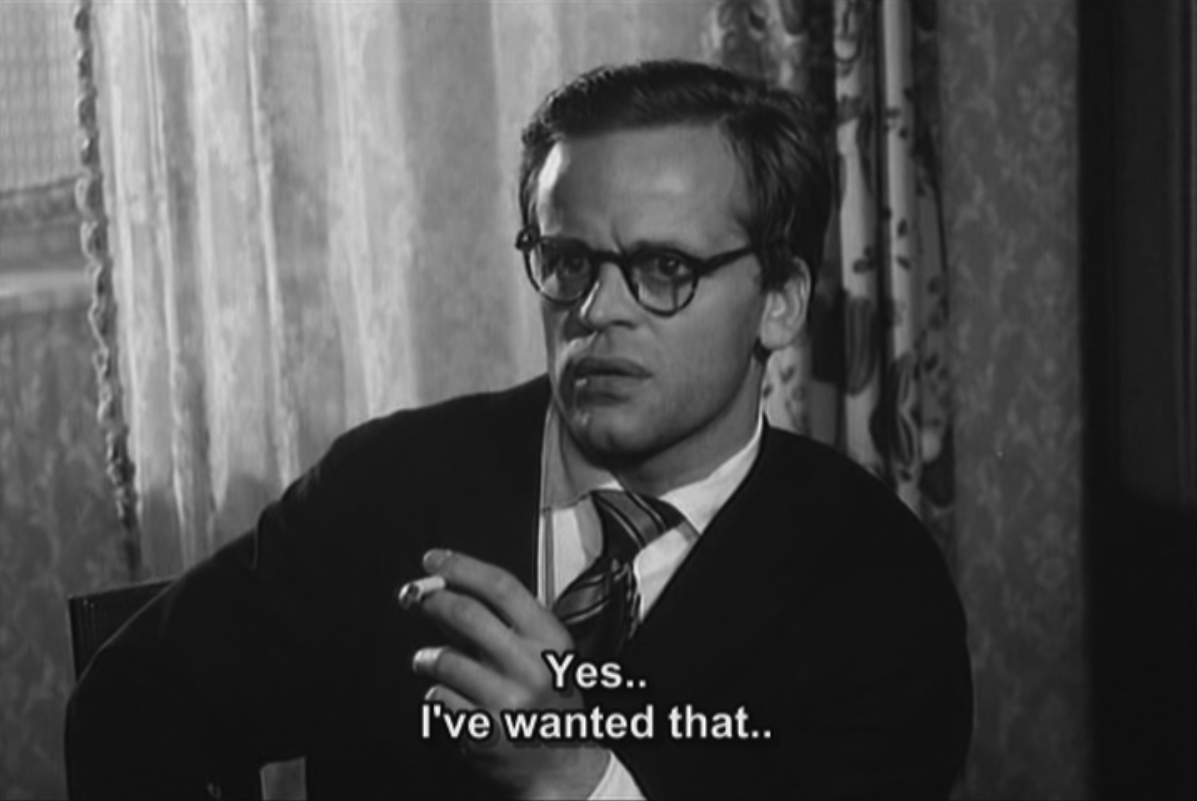
The other is Wolfgang Kieling, who plays the dead man’s estranged brother, his de facto heir despite the fact that the two brothers hated each other in life. He plays it full-tilt Grand Guignol, giving a sweaty, spastic, neurotically terrified performance (both physically, and with his line readings). Slouching and posing in and out of scenes like it’s capital-T-Theater … His highly tailored suits, black leather gloves, and spray-on beard join other iconic character accessories in the genre ... his ill-looking eyes frightened globes projecting weirdness into all he sees.
 |
| Klaus Kinski finally gets a worthy Krimi ringer in Wolfgang Kieling. |

When, at one point in the movie, he’s found on his knees before his own mausoleum stone, taking chunks out of his name with a hammer, what he pulls off reminds me of the best moments of the Price-Poe films. And there are moments in his performance when he manages to conjure the missing Kinski. Like in another scene, he sits in his housecoat theatrically smoking a cigarette while conspicuously wearing those black gloves again ... a shorthand sketch of the decadent, perverted rich, and a kind of visual ringer for Kinski’s house-coating-about in DER RACHER. I'll be very happy to find him in any other Krimi I can.

[BUT ... TOO MANY MORE WEAKNESSES]
Despite these casting strengths (and how indelible the Zombie’s visual signature is), there are too many more elements I can’t justify, or quite get a handle on. For instance, one key character—Ramiro, the local stonecutter—appears in the film decked out in full-body green paint. According to the movie, this paint—his “olive-green skin color” (which is caused by a rare disease and doesn't look olive-green but totally fake)—“allows him to pass as Creole”. Which in turn makes him the film’s resident expert on zombies. I mean, uh, what?
I have no idea what this means, or is trying to imply (or if it’s some form of an “exotic othering” of the character a la Christopher Lee as Fu Manchu or—more problematically—Al Hoosmann's Bhag in the aforementioned RACHER). At the very least, it is unnecessarily distracting. And lets some of the air out of the otherwise weirdo reveal of the film’s climax.
(It makes the slightest bit of thematic sense, as green is a dominant part of the movie’s color scheme—any time the Zombie appears, he tends to be lit in a wash of pale green just as he murders his victims. But still.)
 |
| Ramiro, the green-skinned “West Indian” talks drunkenly about his zombie master, to the disbelieving Pinkas Braun. |
There’s also the film’s awkward, half-baked handling of its zombie theme. One need only think back to the nuance (and genuine creep) of something like Tourneur and Lewton’s I WALKED WITH A ZOMBIE, 1943, to understand how unsatisfyingly rendered things are here:

 |
| A
NIGHT OUT AT YOUR FRIENDLY, NEIGHBORHOOD “ZOMBIE” JOINT: Some of this
cartoonish, even offensive caricature is down to the time period—consider,
e.g., that just a year earlier, in a film as mainstream as YOU ONLY
LIVE TWICE, Sean Connery’s Bond passed as legitimately “Japanese” by
having his eyes “slanted” with prosthetic makeup. And that was
apparently “okay,” not only with everyone involved, but with audiences
too. But some of the treatment here is also just clunky in its execution: Fuchsberger and Pagé go out on a dinner date, to a “West Indian” restaurant that serves a drink called the “Zombie”. Nearly as quick as we get the lame exposition about what zombies are, though, we leave the restaurant because Fuchsberger’s Inspector Higgins is called away to the first murder committed by The Laughing Corpse. The scene is nothing if not unnecessary padding. |
Also ZOMBIE gives us another example of the series’ tendency to shrink from the sexually transgressive limits that previous entries had already broached and passed. It’s a strange, schizophrenic tendency in the genre, a regressive one that makes the chronology of the series feel confused (because you would assume that, as censorship relaxed later in the series, the less hamstrung its portrayal of sexuality would become):
Some of the later, color entries feel like they’ve gone more tame than their black-and-white predecessors, afraid to trespass the same onscreen depiction of sexuality that had taken place during a time of more-stringent censorship. While others feel like they’re pushing so far into unapologetic exploitation that they take your breath away (SOLANGE, both in terms of plot points and onscreen depiction of taboo sexuality, comes to mind).
For example, the sexual politics in New Scotland Yard's office, though played with some of its tongue in cheek in earlier entries like 1964’s DER HEXER, here goes full-on silly, with Ilse Pagé’s Scotland Yard secretary playing a cartoon who goofily plies the unresponsive interest of Joachim Fuchsberger’s “Higgy”. A similar setup is given to Fuchsberger (and his inveterate bachelorhood) in HEXER, but there it feels much more adult; more sensual; more subversive. Not only because there’s actual flashes of nudity, but because the erotic and bodily charge between Fuchsberger and his love interest (played by Sophie Hardy) is palpable. Compare the following sequences, ZOMBIE’s in color, DER HEXER’s in black-and-white:
 |
| Note her childish, immature pouting; the tendency for her character to be played as a one-dimensional cliché of the “lovestruck secretary”. This kind of regressive, adolescent nonsense does these entries no favors. |


 It’s not hard to see which one feels more erotic and adult. Also, in 1964, it seems like at least some of that scene must’ve raised (at the very least) a few eyebrows.
Critic Norbert Grob argued that the best Krimis:
It’s not hard to see which one feels more erotic and adult. Also, in 1964, it seems like at least some of that scene must’ve raised (at the very least) a few eyebrows.
Critic Norbert Grob argued that the best Krimis:
"... play a double-edged game with what happenes on the film's surface and what seems to have happened [my note: not unlike the Giallo’s obsession with the hidden, indecipherable image seen or mis-seen by the film’s protagonist]. What glimmers through is the level at which the images take on a third meaning that tell it like it really is: images of the crude and the garish, of the sardonic and the shocking. These crime films punch a hole in the accustomed order of things. They challenge us to see the world differently, to get away from habitual ways of thinking, to clear the way for imagination ...”
If that is our definition of what the “best” Krimis accomplish, then it becomes at least a little difficult to class THE ZOMBIE WALKS among them.
Leonard Jacobs
July, 2015
[SHOW NOTES]
VERSION WATCHED: Low-quality bootleg | LANGUAGE: German soundtrack with English subs | DIRECTOR: Alfred Vohrer | WRITER(S): Edgar Wallace, Ladislas Fodor | MUSIC: Peter Thomas | CINEMATOGRAPHER: Karl Löb | CAST: Joachim Fuchsberger (Inspektor Higgins); Siw Mattson (Peggy Ward); Wolfgang Kieling (Sir Cecil); Pinkas Braun (The Stranger); Claude Farell (Adela); Peter Mosbacher (Ramiro); Siegfried Rauch (Dr. Brand); Otto Stern (Mr. Merryl); Renate Grosser (Mrs. Potter); Hans Krull (Mr. Potter); Lillemor Lindfors (Sabrina); Ilse Pagé (Miss Finley); Edith Schneider (Professor Bound); Wolfgang Spier (Bannister); Ewa Strömberg (Library Clerk); Jimmy Powell (Casper); Hubert von Meyerinck (Sir Arthur)