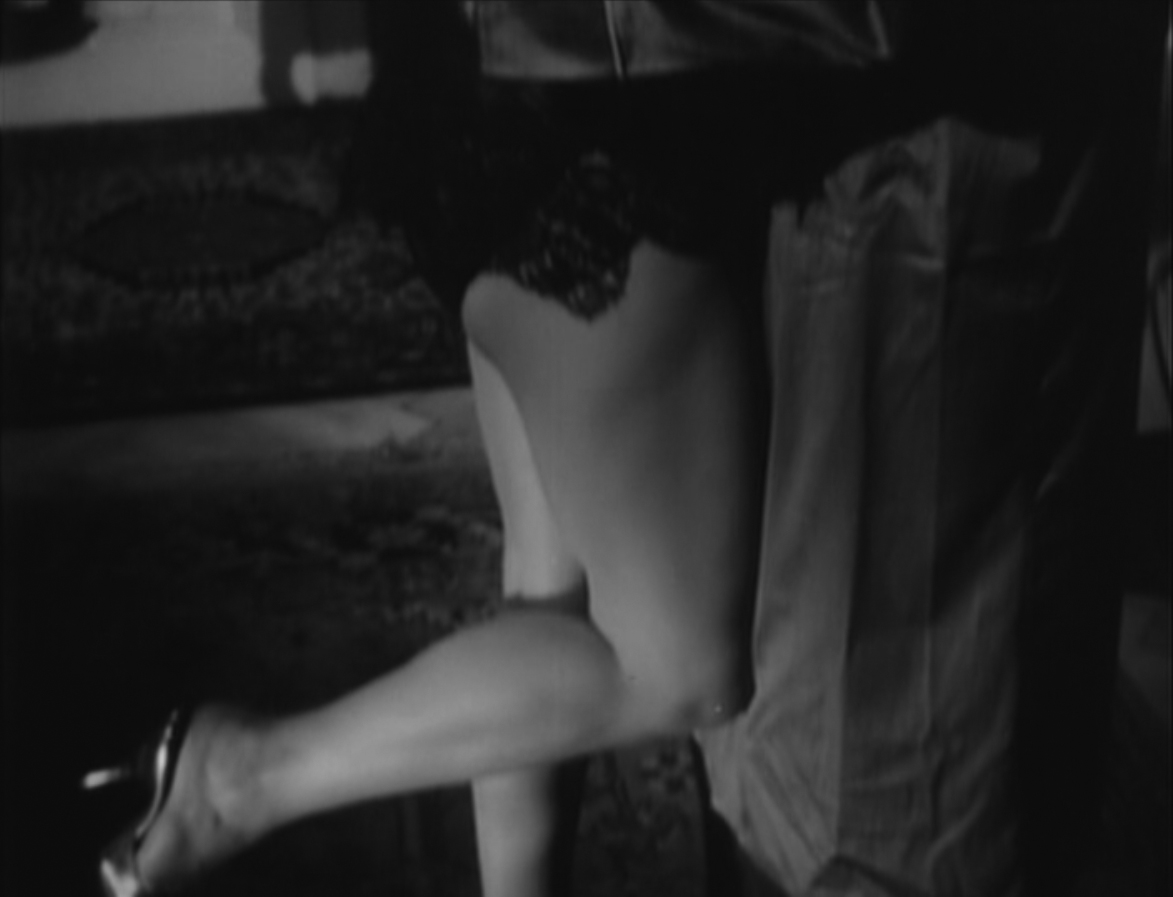
|
| “Who isn’t mad now? Even I might be insane.” Genre darling Karin Dor gives one of her most compelling performances, as the conflicted society-bride Jane. She is strikingly beautiful in the film, and plays a wholly impenetrable character from the start. She is skeptical of her husband's past, skeptical of his reasons for marrying her, skeptical of the possibility of real love ... that her love seems to grow in direct proportion to the likelihood that her husband is a money-forging hammer-killer is just one of the strange, even perverse, elements of the film. She is also remarkable here for how she takes the genre's stock “ingénue-in-distress” character and gives her agency, sustained power, in the face of dominating and ruthless men. She fends them off, bats away their advances, and finds a smirking kind of elan in the face of all her travails. |

[This is the thirty-seventh post in a continuing series discussing and analyzing all the Krimis and Gialli I've seen. As with every post on this site, SPOILERS SHOULD BE EXPECTED. For links to all the other Krimi reviews I’ve posted, go here. For all Giallo reviews, here.]
My Krimi Rating: ★★★½ (out of 5 stars)
Subcategory (if any):
i. Inheritance Scheme Krimi
ii. Ingénue-in-Distress Krimi
iii. Heist / Master Criminal Krimi
iv. Old Dark House Krimi
v. Past Trauma Krimi
Who Portrays the Detective (amateur or official):
Siegfried Lowitz (official)
Who's the Ingénue:
Karin Dor
In My Krimi Top 20 (Y/N): No
[NOT EVERYTHING IN THE KRIMI IS A PUNCHLINE]
I’ll always feel indebted to Kim Newman for my formal introduction to the Rialto Krimis, via his invaluable, 30-page Video Watchdog review of the German box sets, as that article came into my life at a time when I was just starting to wrap my head around the genre. (A time, not really that long ago, when I had zero clue for instance that the German Krimis are as responsible as anything else in the world for what we now call the Italian Giallo.)
The more Krimis I’ve seen though (74 and counting), the more I think his intro and capsule reviews tend to overemphasize one single aspect of the Krimis—and at the expense of all others: I.e., the Krimi’s broadly played comedic elements. And, how these elements take shape—first in the form of stock, “joke characters” (played most often by Eddi Arent), and then in a kind of cartoon aesthetic that manifests itself in set design and décor. (The easiest example of this are those supposedly, screamingly, fake “English” castles and the way they make a mod-but-already-outdated joke out of the Gothic tradition.)
The danger in weighting one’s understanding of the genre so lopsidedly toward its comedy, though, is that fans—new fans esp.—are in danger of missing the other tones (thriller tones, horror-mystery tones, Giallo tones) that get struck from film to film. It runs the risk of reducing the popular understanding of the genre to nothing more or less than the genre’s camp value—a danger I see borne out in review after review. Newman, in his VW review, frames the story in these terms:
“Harald Reinl’s film of the novel THE FORGER aka THE CLEVER ONE (1927) opens at Ascot [horse track], with Oberinspektor Burke (Siegfried Lowitz) in the crowds on the look-out for counterfeit money and der Königen making a guest appearance in grainy news footage. (Actually, if you count portraits on the walls of Scotland Yard, Elizabeth II is in more of these films than Klaus Kinski.) The imaginative title sequence features a magnifying glass passed over a snide note and a jaunty, catchy Martin Böttcher theme. As is often [the case] in the series, an ordinary racket which would have done for a documentary-style crime movie ... leads the investigators to an overdecorated (lots of antlers) and echoey English country house (Longford Castle) and a twisted uppercrust family—not to mention a Mabuse-alike who issues orders over an intercom in an ominous office with two-way mirrors. A SUSPICION element is added as the new bride Jane (Karin Dor) worries about the possible guilt of her high-born husband Peter Clifton (Hellmut Lange). A scream in the night brings her to the balcony, from which she sees her husband sleepwalking suspiciously in the garden. The next day, Peter wakes up covered in blood, having suffered one of his periodic amnesia spells, and an angry ex-suitor of his wife’s is found battered to death in the early morning mist. All this, like the printing press in the cellar, is a dead giveaway as to the innocence of Herr Clifton.”In some ways his review suggests—again, esp. to someone unfamiliar with the genre—that tonally the Krimis can’t ever be taken seriously. That, on balance, they are ridiculous, “camp” concoctions whose empty calories are incapable of sustaining dramatic weight, thriller weight, any weight that doesn’t include its own punchline & pratfall routine.
Of course there’s something to this. One need only experience the bright colors and slapdash, comic-book mechanics of something like THE HUNCHBACK OF SOHO (1966), or THE COLLEGE GIRL MURDERS (1967), or THE MAN WITH THE GLASS EYE (1969) to understand why reviews so often boil them down to nothing more than a wink and a nudge re: how crazy and campy all these weirdo West German mysteries are.
But what you discover, once you get past the proverbial “first row,” is that for every HUNCHBACK OF SOHO, there is a melancholy, moody, experimentally shot Krimi whose existence seems wholly unknown to the average reviewer. Krimis that possess a complexity of style *and* substance that the average review seems incapable of acknowledging. Something like the truly troubling, truly envelope-pushing SIEBEN TAGE FRIST, which is, in its own way, as sexually taboo as WHAT HAVE THEY DONE TO YOUR DAUGHTERS? and as formally innovative as Argento’s OPERA.
That is, for every camp, masked monk (COLLEGE GIRL MURDERS), there is a broken, complicated *human* villain wearing that same mask (THE SINISTER MONK). And, for every passage of vaudeville-style comedy, there is an equally (if not *more*) persuasive passage of what David Sanjek calls Stimmung***:
That peculiar, and indelible, and overriding *mood* that the best Krimis achieve. A grotesque mystery-horror world built out of mixed-and-matched pieces of pulp from who knows how many different cultures—the popular West German cinema’s invention of a made-up 1960s-era London, which is itself, in turn, based on the writings of a hustler-writer Englishman whose novels were already 40 or 50 years old at the time they were being reused.
What is achieved—again, in the best examples of the genre—is something akin to the “imaginary” Italy that Argento achieves in his Gialli, the ones seeded with transplanted, dislocated, even invented chunks of “real” architecture and landscape as a way to world-build the Giallo into its own time and space ... or the way that De Palma invokes, simultaneously, a thriller world that is both real and imaginary, through his obsessive doubling of images and characters, his obsessive layering of misleading soundtracks, his trick-behind-the-trick-behind-the-trick. (For my tastes, DRESSED TO KILL and BODY DOUBLE are his two most perfect examples of this ... two films whose guts also often get glossed over, by critics and their misunderstanding of the “humor” up there on the screen.).
 |
| BONA FIDE GOTHIC ATMOSPHERE: Though many reviewers seem to roll their eyes at the "old dark house" castles that populate this strain of the Krimi, FORGER is chock-full of atmospheric and moving shots that remind me of the Gothic work of Bava / Freda / Margheriti; shots that deserve to be taken seriously on their own terms. |


[WHAT COMES AFTER COMEDY]
So. What reviews of Harald Reinl’s THE FORGER OF LONDON most often seem to mention is how *different* it is from all those endless yuck-yuck examples of the Krimi. What an outlier it is, because it tries to “play things fairly straight”. Because it deliberately ignores the winning box-office formula of a joke Krimi, and instead has a violent, potentially troubling story to tell.
Compare it for instance to the same year’s GREEN ARCHER, also starring Karin Dor. There a mugging, schlubbing Eddi Arent plays a cartoon of a journalist named Spike Holland. He opens the movie by jokingly breaking the fourth wall, insisting that this Krimi can’t start because there hasn’t been a murder.
And he ends it by becoming the butt of the genre’s oft-used “Ende gag”: He ends the movie by taking an arrow in the back. But like any good Three Stooges routine, the arrow doesn’t wound him mortally, it only pins the word “Ende” onto the back of this ass, a hokey signal to the audience that their time in the Krimi-verse, for the moment at least, has come to an end.
(The persistence of the Ende gag makes for an interesting echo, when you watch the Lang MABUSE movies that are so key to the staging, styling, and storytelling of the Krimi. In the MABUSE movies, the expressionistic and exaggerated appearance of the Ende-sign Lang uses tracks with the overall feeling of disorientation and unease. In the Krimi, they mostly invite a reading that is hokey and watered down.)
But there are no such gags in FORGER, where Eddi Arent’s reduced to little more than a forgettable cameo, and the well-familiar inheritance plot plays cover for a complicated, even perverted critique of what it means to enter into the marriage bed ... a critique that gives us a window into what unsettles these otherwise “jokey” mysteries.
I.e., because so much of the humor (and the attending distraction it causes) is stripped away in FORGER, we’re left to really focus on the fate of the lead female character played by Karin Dor, here playing one of her umpteen versions of the genre’s ingénue-in-distress. Because the stock ingénue character shows up so often in Krimis, it’s no surprise we get one here—no surprise that much of the plot is driven by some grasping man’s attempt to both steal her inheritance and dominate her mentally. But that's the rub:
Usually this unctuous, repugnant attempt to dominate women—orchestrated here by what Newman so brilliantly calls a “Mabuse-alike” villain in the cast—gets tempered, even canceled out, by the jokes. So it's easy to laugh off the otherwise disturbing implications of a world filled with shrill, abusive men who use their power to do nothing but dominate—socially dominate, sexually dominate, emotionally dominate—the female characters in the film (and female characters, it must be mentioned, who are most often decades younger than their assaulting men, an age difference that adds a certain level of obscenity to the crime).
In short, FORGER gives us an insight into the genre that goes past the thumbnail reviews and headline reductions—past the surface understanding and surface appreciation—and lands us securely into the uneasy position of grappling with what I’ll call (for lack of a better term) the genre’s “Male Menace”.
(Arent is so MIA from the movie that I started to seriously wonder if they were saving him, waiting to reveal him as the faceless villain pulling everyone’s strings. The “Arent-as-Villain” sub-genre of the Krimi did take off later—with him giving us interesting and layered takes on the Krimi villain in THE SINISTER MONK, CIRCUS OF FEAR, HUNCHBACK OF SOHO, THE TRYGON FACTOR, etc. But here he’s a shadow of his usual shtick: a bumbling neighbor who lives next door to one of the crime scenes. He gets some brief, and pointless, physical comedy in his first scene, and then doesn’t show up again until film’s end, in an even briefer cameo.)
[THE MALE MENACE]
So what am I talking about when it comes to this overriding threat, coming from the Krimi’s veritable parade of possessive, violent, even sexually abusive men? In FORGER we get it from the start, first in a kind of existential dread that both Dor and her husband suffer on the eve of their marriage: Dor’s character fears that, in her world, “love” can never be enough for her troubled husband. And he fears that the mysterious secret that haunts his past will also, by way of their marriage, come to haunt and dominate her.
 |
| THE MARRIAGE KNOT: From the start, the “wonderful couple,” whose union is the “envy of all of London,” doubt that anything of the sort could be true. Instead they suffer under a total lack of intimacy (not to mention: sexual desire) that makes things between them icy, awkward, and hard to watch. |


And then, walking parallel to their troubled marriage, is that parade of hideous men. There’s the high-society gadabout who openly propositions Dor (even though his manners—and human decency—should prevent it), and who more than once threatens the life of her husband. There’s her ailing father-figure, who uses her love for him to guilt her into a marriage she doubts from the start. There’s the second-in-command police inspector, who seems happy to find Dor and her husband guilty of the crimes he himself has committed. And there’s her husband’s oily old doctor, who takes every chance he gets alone with Dor to try to entice her with his silver-fox (but sagging) charm.
 |
| MALE MENACE NO. 1: We’re introduced to Robert Graf in the film’s racetrack prologue. There he hits on Dor’s character—even though her much-feted marriage is imminent—and openly mocks her engagement. His mental / emotional abuse of her even gets some air, as he suggests he possesses secret knowledge of her fiancé that will ruin the both of them. On their wedding day he shows up at the reception sloshed, makes loud, inappropriate comments about her “role” as future mother and wife, and is thrown out. Later he enters Dor’s bedroom as she sleeps, chokes her, then kisses her, and then escapes. He is a smug, slimy male—so hurt by Dor’s rejection of him that he’s determined to have her at any cost. |
 |
| MALE MENACE NO. 2: Krimi regular Walter Rilla plays Dor’s seemingly well-intentioned uncle. He uses his excuse of poor health as a way to guilt trip her into marriage, even after she confides to him that she thinks the marriage will be an emotional sham. In the sublime ROOM 13 (1964), he played another father-figure in Dor’s life, her actual father, a wealthy upper-cruster whose past sins have come to be visited upon his daughter’s head. In both films, he betrays Dor, using his status as “father” to further leverage her will. |
 |
| MALE MENACE NO. 3: One of my favorite Krimi players, Ulrich Beiger. He plays the second detective in the film, who may or may not be trying to frame Dor and/or her husband. He’s on the Krimi scene from the first “official” entry, 1959’s FACE OF THE FROG, where he is one of the Frog’s knife-men. He makes his most delirious, menacing impression in Harald Reinl’s near-flawless THE TERRIBLE PEOPLE (1960), including a scene where he tries to force marriage on Dor (the scene is one of the weirdest in the entire genre, esp. as he seems to have a kind of psychotic break in the middle of it) … he also helps throw a woman, who’s tied to a chair, down a three-story hole to her death (extensive review, including caps of those scenes, here). |
 |
| MALE MENACE NO. 4: It doesn’t take long for the silver-fox doctor—who’s been doping Dor’s husband while also seeding his mind with delusions of mental illness—to go into full-on creeper mode and proposition Dor. While visiting the couple to minister to her husband’s strange blackouts, his “missing time,” he comes right out with it once he has Dor alone. Even though she clearly wants none of it, and is offended that her husband’s confidante would so quickly go rotten on him ... so many male characters in these movies do nothing but betray—callously betray—the confidences they’ve been given. (Note also those thoroughly modern paintings, as visual counterpoint to the film’s “old-fashioned” Gothic tones.) |
Think Marisa Mell’s unexpected inheritance in THE PUZZLE OF THE RED ORCHID, and the way that warring gangsters (and their surrogates) seek to “relieve her” of it. Or Sabine Sesselmann’s unsuspecting character in THE DOOR WITH THE SEVEN LOCKS, where a whole cadre of Wallace grotesques—Werner Peters playing a child-sized version of his usual no-good, Pinkas Braun playing a low-rent and ridiculous Dr. Moreau, Hans Nielsen playing a lawyer with a wooden hand—are conspiring to keep her from knowing of the enormous sum of money that should be hers.
Also: To dominate them sexually. As touched upon above, this often takes the form of a much older man who uses his “worldly wisdom” and father-figure status to convince, under duress, the ingénue-in-question to marry them. One of those enslaved-for-life marriages that they’ll never, for the life of them, be able to escape: think Brigitte Grothum in INN ON THE RIVER, and the way she’s manipulated by a criminal syndicate (and one man old enough to be her father) into an arranged marriage that she most assuredly does not want.
There’s also Reinl’s staging of this theme: Though not quite the same caliber as those famous breakfast table scenes in CITIZEN KANE, where the length of the table and passage of time goes to show the increasing marital divide between Kane and his unhappy wife, Reinl’s version is a nice riff that gives us the clearest of windows onto this married life. The first night of their honeymoon, dining in Longford Castle, finds them already at arm’s length. The scene suggests no love, no intimacy—a suggestion that only gets underlined when, on her way to bed, alone, Dor stoically invites her husband to accompany her by conceding that a husband “has certain rights”. In this instance, he does not claim them:


It also seems a pretty damning comment on marriage: Dor is attacked in her sleep by a man who chokes her as he forces his lips onto hers, and he is only able to do this because she has rejected her husband on their wedding night. We get a version of a world where, no matter their standing in society, the female characters exist under that constant threat of attack. If they reject their husbands “rights,” they also lose any chance to be protected by them. And if they submit to their husbands—in situations where they are not truly in love, guilted into a marriage they did not really want—it is its own kind of attack. An attack on their sense of self, their individuality, their right to exist autonomous in the world.
There is no security—let alone sanctity—no matter what they do. Whatever their choice, they find a marriage bed that is as cold, violent, and unsafe as if they went ahead in the world on their own. At every turn men want to possess them, violate them, lord over them (by exploiting the law, societal mores, or just robbing them blind).
Here, Dor’s earnest, honest attempts to connect with a husband who keeps her at arm’s length—her willingness to break the law herself in an attempt to keep him from being punished for a crime she may or may not believe he’s committed—her genuinely conflicted expression of a forward-looking, “modern” woman who has come to believe that maybe the institution of marriage is obsolete, and she would be better off insisting on a life outside it ... all of these layered, at-odds expressions of her character (her “stand-up” if you will) are trampled on by the boorish, pig-headed, abusive men. Men who see her as a possession, an exploitable means to an end.
...
That she and her husband are eventually vindicated (and through no small help from one of the only other non-villainous males in the cast, the chief inspector played by Lowitz) does little, really, to counteract the profound angst that has been radiating from her up till then. In much the same way that the “solutions” to most Gialli fail, really, to solve the existential uncertainty raised by the events of the film, so too does Dor’s eventual “happy ending”—an ending that does little to convince the viewer of Dor’s ability, as a woman in the Krimi-verse, to “win”.
(For more on the notion of the happy ending in the Krimi, go here.)
...
I realize that, in comparison to the examples of sexual sadism, gang rape, mental torture, etc. made so explicit in modern films, these half-buried, part-implied subtexts—their subtlety—is maybe harder to latch onto and appreciate. But under the Krimi’s bumbling comedy, the Old Dark House setting, the sometimes creaky dialogue and plot mechanic, it’s there. And the more Krimis you watch, the more this nagging, disconcerting trauma insists ... that it too often gets obscured by slapstick and laughs doesn’t mean it isn’t there. Or that it’ll ever get fixed.
Leonard Jaocbs
April, 2016
***I’ve covered this concept several times already. For reference sake, here’s the relevant text that I quoted in my review of 1960’s THE AVENGER:
“... [Krimis] play a double-edged game with what happens on the film's surface and what seems to have happened. What glimmers through is the level at which the images take on a third meaning that tell it like it really is: images of the crude and the garish, of the sardonic and the shocking. These crime films punch a hole in the accustomed order of things. They challenge us to see the world differently, to get away from habitual ways of thinking, to clear the way for imagination ... the special ambiance of the series was calculated, a unique combination of crime and horror ... what counted was the atmospheric setting: the dimly perceived threat that undermines every sense of security, the half-darkness, all of which contributed to an eerie mood of nightmare and terror.”The appearance of a similar strategy in certain Japanese Noir movies has also been discussed by Jasper Sharp, something he calls Mukokuseki. His description sounds very much like he’s describing a Krimi:
“... representative of a more hardboiled strain of Nikkatsu Action movie that became increasingly stylized and self-referential over the next decade. They often deployed the same acting talent, with male stars such as Jo Shishido and Hideaki Nitani moving from supporting to more centre-stage roles, and invoked mukokuseki (‘borderless’) onscreen worlds that, in their embrace of an aesthetic and iconography gleaned from the international language of foreign pulp cinema of the same vein, seemed more and more divorced from any recognisable, lived-in Japanese reality, while simultaneously expressing a sense of cynicism and despair at the path up which modernity was leading the country. When combined with some of the most striking and idiosyncratic monochrome widescreen scope cinematography seen anywhere in the world at the time, certain titles transcended their modest potboiler ambitions to find their place within the loftier echelons of cinematic artistry.”
[SHOW NOTES]
VERSION WATCHED: I have the German DVD release, which has significantly better a/v than the bootleg US disc(s); it also seems to be a bit longer. The problem is that it offers no English options. So I watched the film a few times, toggling back and forth between the superior a/v of the German disc and the English dub on the crap US bootleg, which I needed in order to get the gist of the dialogue | LANGUAGE: Very unsatisfying English dub. | DIRECTOR: Harald Reinl | WRITER(S): Edgar Wallace, Johannes Kai | MUSIC: Martin Böttcher | CINEMATOGRAPHER: Karl Löb | CAST: Karin Dor (Jane Clifton, geb. Leith); Hellmut Lange (Peter Clifton, geb. Welerson); Siegfried Lowitz (Oberinspektor Bourke); Mady Rahl (Marjorie Wells); Walter Rilla (John Leith); Robert Graf (Basil Hale); Joseph Offenbach (Henry); Ulrich Beiger (Inspektor Rouper); Otto Collin (Rechtsanwalt Radlow); Sigrid von Richthofen (Mrs. Anderson); Eddi Arent (Nachbar Stone / Organist Miller); Viktor de Kowa (Dr. Donald Wells)