|
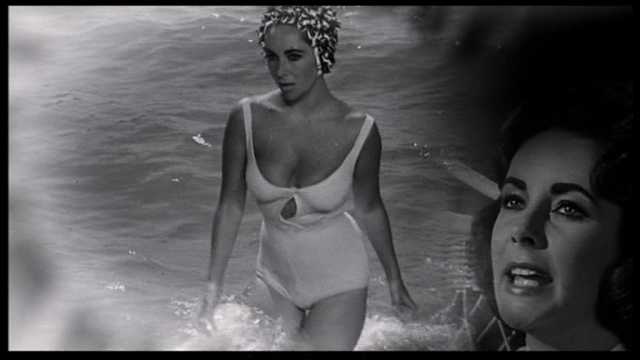
| There must have been something in the air in 1964. Not only did the Krimis begin to relax the embargo on onscreen nudity, two of the Bryan Edgar Wallace adaptations from this year—this and THE PHANTOM OF SOHO—show a strong affinity with the seminal Giallo BLOOD AND BLACK LACE, all three echoing some of the same style and iconography re: the construction of the "black-gloved killer". (Some brief examples of these visual similarities are suggested here.) They'd make for quite the triple bill. |
[Note:
This is the twelfth post in a continuing series discussing and analyzing
all the Krimis and Gialli I've seen. As with every post on this site, SPOILERS SHOULD BE EXPECTED. ALSO, SOME IMAGES IN THIS POST ARE NSFW.]
My Krimi Rating: ★★★★½ (out of 5★)
Subcategory (if any):
i. Proto-Giallo Krimi
ii. Ingénue in Distress Krimi
Who Portrays the Detective (amateur or official):
Hansjörg Felmy (amateur); Manfred Grothe (official)
Who's the Ingénue:
Marianne Koch
In My Krimi Top 20 (Y/N): Yes (Letterboxd link)
I've watched this twice now, in the past two months. The first time I was fatally distracted by the truly annoying comic relief, what constitutes an entire subplot with a husband-and-wife team of private eyes bungling all their attempts to win the reward for the capture of the film's “Jack the Ripper killer”. (To be precise, the English dub suggests they’ve yet to get married because of lack of funds. Not that it matters, in terms of story or characterization.) We get cartoonish scenes of their domestic “bliss,” with (for instance) the couple filmed in bed beneath an enormous pillow blanket, each pulling at the other's share because of how cold it is in the apartment. We get the boneheaded insertion of the team into the film's play-within-a-play, first the husband posing as one of the play's Scotland Yard bobbies—he shows up on stage during the wrong scene and goes headfirst through a prop window as he’s laughed off-stage—and then the wife, posing as a big-bosomed wannabe starlet who’s intent on replacing the play’s lead female, once the real-life Ripper murders her. As with Eddi Arent's worst performances in the genre, this broadly comic, cringe-inducing "relief" can be deadly for a given picture's effectiveness.
(On a related note—one further reinforcing the through-line from Krimi to Giallo—I have this same problem with Argento's films, even some of his most acclaimed. FOUR FLIES ON GREY VELVET, despite it constantly upping the style ante, the experimental-detective-story ante—despite the fact that I find the hyper-slow motion ending that gives us Mimsy Farmer's blinking decapitation-by-truck-bumper to be one of *the* key, all-time Giallo moments—I find the jokey subplot with the tramp “God” character and the mustachioed mailman almost unwatchable. And there are plenty of other examples: the ridiculous, sitcom arm-wrestling match between Hemmings and Nicolodi in DEEP RED [also, in that movie, the running gag with her car]. Or all the time spent in BIRD WITH THE CRYSTAL PLUMAGE building up to the reveal that eccentric painter Mario Adorf fattens up his cats because he eats them [and has just fed one to Tony Musante]. These tonal shifts don't work for me in the best examples of the genre, and are certainly one of the reasons that I find movies like TENEBRAE and OPERA to be so superior to the rest of Argento's Gialli. Because they do that rarest of things in the genre: They actually integrate their comedy in organic and effective ways.)
So, before writing MONSTER up, I decided to revisit it and see if I could get past this distractingly bad humor and instead see the merits of another Bryan Edgar Wallace entry in the genre. And … to a great extent, I did.


[MURDERS FROM THE FUTURE]
Like PHANTOM OF SOHO, MONSTER OF LONDON CITY excels in the forward-looking stylization of both the murderer and his crimes. The inky silhouette that he strikes in the frame. The angles of his black hat, black trench, and black, grasping, razor-wielding hands. Everything about him not only shares several aspects of the template-making look of Giallo killers (as established in the same year's BLOOD AND BLACK LACE), but feels, repeatedly, like it prefigures the iconography used by any number of later slashers and psychothrillers (more than once I flashed on De Palma's DRESSED TO KILL while watching the killer here). The screen time and visuals devoted to the stalking, slashing, and Jack the Ripper-mutilating (only described, off-screen and after the fact) very much feels like proto-Giallo territory, and cements it firmly in the “non-old-fashioned-feeling” category of Krimis I’ve seen. (Some of this is down to simple chronology, but even some of the later entries—say, 1967’s THE COLLEGE GIRL MURDERS—feel hopelessly dated in the face of earlier entries like ROOM 13 or DER HEXER.)


[CHARACTERIZATION & CASTING THAT SHOWS SURPRISING DEPTH]
It’s a cliché to say that genre films often suffer from thinly drawn characters, z-grade casting, and a complete lack of narrative interest in anything but fashioning (as David Sanjek described it, in conjunction with Wallace’s writing) “event-filled, breathless narratives”. Narratives that then became even more event-filled and breathless in their Giallo permutations, showing a “tendency to engage in technical and narrative experimentation as a response to market forces which encourage violent excess and visual bravado as convenient means of capturing a public easily wearied by standard cinematic fare.” (The idea that Krimis and Gialli were competing with each other for market share, and that this competition for ticket sales was, as much as anything else, the condition that allowed for such radical experimentation in an otherwise pulped genre is one of Sanjek’s most interesting observations.)
Just like it’s old hat to see someone argue that “you don’t watch an Argento movie for the acting!” (or, they’d argue, the story), it feels like old hat to expect these Krimi stories to be populated with stock, one-dimensional ciphers whose plot function trumps any understanding (or presentation) of who they might be as fictional human beings (with an accompanying interior life).
That assessment/expectation is pretty spot on when it comes to the comedy duo in the movie—also some of the more obvious red herrings, including the stiff-upper-lipped, morally outraged member of Parliament—but not, when we get to the male and female leads.
The
film's female lead, played by Marianne Koch, is the niece of the prudish,
egotistical Parliamentary “Sir” (Fritz Tillmann). She has had a
long-running relationship with the Scotland Yard doctor who has been
tasked with doing the autopsies on each victim (Dr. Morel Greely, played
by Dietmar Schönherr). At some point during this relationship, we learn
that Koch has fallen out of love with the doctor and has fallen *in*
love with his best friend, the damaged actor who portrays Jack the
Ripper each night on stage, Richard Sand (garnering both governmental
outrage and controversial, public acclaim; here he's played by Hansjörg
Felmy). The love triangle subplot is not worth noting in itself, but the
way that she moves within the potentially tired confines of this plot
makes things feel more layered, more distinctive.
 |
| As
is par for the Krimi course, the narrative landscape is crowded with
red herrings. Red Herring #1: Could Koch’s puritanical Uncle (Fritz Tillmann) be the repressed killer? Why does he dress up like Jack the Ripper and sneak out of the house each night? |
 |
| Red Herring #2: Could Sand's shifty assistant-slash-stage manager be setting up his boss to take the fall? |
 |
| Red Herring #3: Could the play’s producer be murdering women as a means of ensuring the success of his play? |
 |
| Red Herring #4: Or could it be the narrative (and historical) ringer—the police doctor, Dr. Morel Greely, whose professional knowledge grants him the precision and skill that keeps showing up in the mutilation of the bodies? |
For one, Koch isn’t done up in a way that suggests she’s supposed to have the pinup good looks of a Karin Dor. She’s presented as the film’s chief “love interest” in a way that seems more mature, more realistic, more believable—in a way that seems as interested in who she is as a person (her personality) as mere “ingénue-in-distress eye candy”.
One way this manifests in the movie is in her reaction to her Uncle’s sexism. Because he is a man, a powerful man, a government minister, and—most of all—her legal guardian, he presumes that (by all the power vested in him by patriarchy) he can control her life as he likes. Once he learns that she's in love with the degenerate Jack the Ripper actor—Uncle has pledged to get the government to shut the play down, to stop the moral outrage and public menace that it (and he) represents—he matter-of-factly forbids her to ever see him again. Despite the fact that Sand professes his love for her—and she his love for him—her Uncle believes he can simply tell her to turn that love off because he doesn’t approve of it.
 |
| Sir Uncle, looking askance at the damned, degenerate actor. |
 |
| The love triangle, from left: Dr. Morel Greely (Dietmar Schönherr), the man tasked with doing the autopsies on the butchered victims; Ann Morlay (Marianne Koch), the doctor's love interest (who is no longer interested); and actor Richard Sand (Hansjörg
Felmy), the doctor's best friend *and* his new rival in love. |
 |
| The wonderful Ms. Koch. It took me till the second viewing to realize that she was the same actress who plays Joachim Fuchsberger's dissolute, bisexual wife in Antonio Margheriti's masterful Gothic mood piece THE UNNATURALS (aka, SCREAMS IN THE NIGHT [1969]). |
Her reaction when her Uncle passes his edict on her life? She rolls her eyes, smiles condescendingly, happily, like you might at a child who has no idea what he’s talking about. Her unperturbed, even giddy response—not taking her Uncle’s authority over her love life seriously—forcefully and cleverly lays his identity bare for what it really is: An empty male fantasy. One that her passionate, unflappable awareness (also: assertion) of her own identity simply won’t acknowledge as being a valid response (or a real system that anyone can force her to live under).
Without overstating it, it feels like a surprisingly progressive take on the “damsel in distress” aspect of most female leads in these two genres (Edwige Fenech, e.g., would go on playing such damsels, wholly reliant on male help, on male authority, for years to come). And makes her seem an actual character, actually drawn.
And that’s not to say that she isn’t also an alluring presence, a sensual presence, as the film’s female lead. Part of this allure comes in the abovementioned way that she carries herself. Part of it comes in moments like the one where she kisses Sand, open-mouthed and full of abandon, even as Greely and her Uncle wait in a nearby room, liable to discover them in mid-kiss at any moment. (Plus also details like the way she’s dressed here: in a plain black dress that has a star-shaped “keyhole slit” resting on her cleavage).
 |
| Tryst, and aftermath. |
[MISCELLANEOUS WHAT'S LEFT]
- Plus
other things that feel more modern: 1. There’s a subplot that involves a
mystery man hidden away in an asylum because he has gone mad from an unnamed venereal disease. 2. There’s a pretty effective handling of the stage play scenes,
both in terms of the public's shocked reaction to the infamy of
the play, and as a window into Sand’s ever-eroding psyche, as he is
forced (by his own success) to continue to play a role, night in, night
out, that inches him ever closer to a relapse in his past. (I could say more about his
character as well, in terms of nuance—the genuinely pained
expressions that play across his face as it becomes ever clearer that
Scotland Yard suspects him of the murders; his growing suspicion that the “blackouts” he keeps
experiencing may in fact be his rational mind’s way of hiding his
culpability from himself; the way he projects a fragile and unsure sense
of self in the small physical details that come across, like the self-defeating way he ties his house robe, etc.—but,
again, I don’t want to risk overstating the vibes I got from these
performances in the film.
- It’s also maybe more than coincidence that I ended up discussing Argento’s OPERA and Edwin Zbonek’s MONSTER
in such close proximity here on the site. Both take the tried-and-true
play-within-a-play mystery formula—wherein the backstage “channel” that
runs from the characters-in-the-movie playing additional characters in a play (that's occurring inside the frame
movie) provides the “narrative bleed” between staged crimes and actual
crimes—and manage to wield it in ways that achieve satisfying effect.
- The movie repeatedly pairs its pushing of the nudity envelope with the broad comedy of the detective couple. Here, they sneak around backstage, only to find a naked actress running out of a scene:

Later, when the male comedy boob blunders his way on stage, he encounters an actual one:


- And then there's the film's DEEP RED moment: In Thomas Rostock’s commentary on DEEP RED, he spends a fair amount of time discussing the scene in Mark’s apartment, when he is sitting at his piano composing. As he sits there, we’re given shots of the killer finding a way to break into the apartment. At some point, Mark realizes that this is going on, and that the murderer is making his way toward the piano to (presumably) murder him.
There is a moment when the camera captures the killer’s
shadow, coming through the doorway into the room where Mark sits at his
piano. The way the scene is shot, it would seem to be physically impossible for Mark *not* to see
the killer and/or the killer's face. Rostock argues that this is the moment when the movie tips
into full-on dream logic, rejecting any kind of objective “solution” to
the story—any kind of objective detection methods that can still be used
to solve anything, any kind of objective physical reality—and instead fully embraces a purely subjective world
for the characters, one where they not only fail to understand what they
see (or hear), but one where they can no longer trust that what they’re
seeing and hearing exists anywhere but in their traumatized minds.
Though I’m sure it’s only coincidence, a surprisingly similar moment occurs when Koch spies on her Uncle during one of his mysterious nighttime excursions. Her Uncle looks directly at the doorway to his study. It is opened a crack, and the outline of someone standing on the other side of the glass is clear (even if the person’s identity isn’t; even with the subpar video quality on the DVD, it's easy enough to see Marianne Koch, standing only partially hidden behind the door; both her pajamas are visible where the sliding doors are slightly ajar, and the smudgy outline of her body through the frosted glass itself). Her Uncle stares at her in the doorway, and then proceeds to act as if he hasn’t seen anything at all. He continues sneaking out of his study as if there's no chance that he's being watched. It’s a moment that has felt oddly unexplained both times I’ve watched the movie.


 |
| Here,
after donning his Jack the Ripper-ish hat and cape, he turns back
toward the doorway where Koch is *clearly* visible. And yet … he acts as
though he can't see her there, staring at him. Despite the fact that,
as he exits his study, it appears as though he is continuing to
stare directly at the doorway where she's standing. From a
narrative standpoint, it makes no rational sense that 1. He wouldn’t be
able to see her and 2. That he wouldn’t react somehow to her, as he can
now no longer sneak out of the house undetected. Unlike Rostock's DEEP RED explanation, here, it’s less clear what the moment is supposed to mean. |


 |
| Furthermore, somehow
Koch remains invisible even as her Uncle’s confidante, his house maid,
covers his tracks in the den. She crosses the room twice, with Koch in
full view, standing in the opening of the door (that’s the back of her
head there, leaving the right-hand side of the frame in the middle cap). Again, this makes
no literal sense, and suggests that something else, something more
subjective, perhaps even internal (i.e., the pov from inside someone’s
head) is going on. |
If
the movie were able to marshal this kind of forward-looking,
surprisingly layered, presciently subjective sort of narrative for
its entire running time, I’d be talking about it in regards to my top Krimi spot. As it doesn't, instead I see it (still) somewhere in my top 10.
Leonard Jacobs
October, 2014
[SHOW NOTES]
VERSION WATCHED: The Image Entertainment DVD (which now appears to be OOP); it's full of problems, the worst being part of the Felmy/Koch kissing scene that gets spliced into a wrong spot, later in the movie. | LANGUAGE: The English dub; like the dub of PHANTOM OF SOHO, I didn't find it that distracting, which is an exception when it comes to these movies (still, I'd very much like to watch it in German). | DIRECTOR: Edwin Zbonek | WRITER(S): Robert A. Stemmle, Bryan Edgar Wallace | MUSIC: Martin Böttcher | CINEMATOGRAPHER: Siegfried Hold | CAST: Hansjörg Felmy (Richard Sand); Marianne Koch (Ann Morlay); Dietmar Schönherr (Dr. Morely Greely/Michael); Hans Nielsen (Dorne); Chariklia Baxevanos (Betty Ball); Fritz Tillmann (Sir George); Walter Pfeil (Horrlick); Peer Schmidt (Teddy Flynn); Kurd Pieritz (Maylor); Elsa Wagner (Housekeeper); Adelheid Hinz (Maid); Gerda Blisse (Assistant); Manfred Grothe (Detective); Kai Fischer (Helen Capstick); Gudrun Schmidt-May (Evelyn Nichols)