Showing posts with label Man with the Glass Eye. Show all posts

11.04.2014

#011 KRIMI POCKET REVIEW [CIRCUS OF FEAR aka PSYCHO-CIRCUS (1966)]

Kinski on the bridge ...
Margaret Lee is running out of options ...
A title card that feels decidedly un-Krimi-like.

[Note: This is the fifteenth post in a continuing series discussing and analyzing all the Krimis and Gialli I've seen. As with every post on this site, SPOILERS SHOULD BE EXPECTED.]


My Krimi Rating: ★★★½ (out of 5★)
Subcategory (if any): 
     i. Heist / Master Criminal Krimi
     ii. Arent-as-Comedy-Routine Krimi

     iii. Arent-as-Villain Krimi
     iv. Kinski-as-Grotesque Krimi  

     v.  Proto-Giallo Krimi 
Who Portrays the Detective (amateur or official): 
     Heinz Drache (amateur); Leo Genn (official)
 
Who's the Ingénue: 
     Doesn't have one 
 

In My Krimi Top 20 (Y/N): Yes (Letterboxd link)


(NOTE: Before I knew what a Krimi was, somebody described CIRCUS OF FEAR to me as an old-fashioned Giallo. Watching it in this frame of mind was, needless to say, an enormous letdown, and made me dislike the movie quite a bit on that first watch. Also, purely as a matter of personal taste, almost all the scenes with the animals—esp. the poor elephants—just depress the heck out of me.)

♫ It's election night in America, and / I just feel like watching a Krimi ... ♫ 

Though I stand by the assertion that the Krimi’s switch to color signaled the end of its golden (and black-and-white) age, there *are* color Krimis out there worth watching. If the colorless-color remake of THE DEAD EYES OF LONDON is one of the worst color examples of the genre’s decline—all around a blandly perverse, blandly cast, blandly executed example of what the Krimi becomes when drained of its uniquely grotesque staging and atmospheres (also, any sense of the genuine playfulness of its experimental glee)—1966’s CIRCUS OF FEAR is a more “traditional” (also slightly dated) example that manages to still feel at home in the upper percentiles of the genre.

More traditional, but done in a non-traditional way. Instead of  the tradition of shooting a UK-set film in Germany, with highly artificial use of London landmark stock footage to “convince” viewers they’re watching a movie taking place in England, here we have a UK co-production, directed and scripted by Englishmen (John Llewellyn Moxey and Harry Alan Towers, respectively), with an opening prologue that was actually shot (on a Sunday, Moxey says in the commentary) on London’s Tower Bridge.

The film’s traditional start, with what seems like an Edgar Wallace gangland/heist prologue—the gang uses Tower Bridge as a staging area to waylay and rob a bank truck—quickly shifts to something more akin to earlier Rialto pictures, with an emphasis on garish, ostentatious characters and a sometimes-inspired use of a traveling circus going to stay at its “winter quarters” as the site of the rest of the movie.

Also non-traditional: The fact that the German portion of the cast is in the minority when it comes to casting. Moxey says that the “German contingent” of Krimi actors were “part of the package” tied to the German money that co-funded the film. That contingent consists of three of the most visible and recurring of Rialto’s players—Heinz Drache (who usually, though not always, serves in the role of hero detective), Eddi Arent (who occupies different levels of comic relief, depending on how broad the script calls on him to play), and of course Klaus Kinski. (Moxey, in the commentary, keeps marveling at what a “great face” Kinski has onscreen—that his big-eyed skull-mask largely equals his effectiveness at this point in his career.) 

(I’ll also admit that my appreciation of the Krimis I’m now revisiting have in some cases shifted as I’ve seen more of the later Rialto pictures. Whether this is a form of nostalgia that should be avoided, or simply an example of having a better context—with each, next film seen—in which to evaluate their varying degrees of quality, I can’t really say … certainly this growing context has allowed me to write at greater length about CoF, and in a way that’s more constructive than in my last review.)

A film full of faces (some familiar; some not) ...

Genre stalwart Heinz Drache.
Christoper Lee, hiding behind the mask.
Leo Genn, nothing if not upstanding and proper.
Suzy Kendall, just a few years before her role in BIRD WITH THE CRYSTAL PLUMAGE.
Krimis can always use more Kinski ...
... and more men in masks.

Non-traditional characteristic #3: The film’s “preferred” soundtrack is the English one, and as far as I can tell contains the German actors’ actual voices, dubbing themselves in English. Kinski’s low, disaffected drawl of the lines—“I want wooorrrrkkkk … not hard wooorrrkkkk…”—makes me smile every time I hear it, and helps enlarge his character in my memory of the movie, despite his limited screen time. In fact hearing the actual voices of all three speak English makes me happy, after all the awful dub jobs I’ve heard trying to track these movies down.

The other big draw, I would guess at least at the time, was Christopher Lee. He plays a hooded lion tamer, whose face was scarred beyond recognition by an encounter with one of the big cats, and who has a twin brother who went to jail for murdering Drache’s father. He’s forceful, even behind the mask, and is never not a presence in the film.

As with many of the plot- and twist-heavy Krimis, though, this one lives and dies by how deftly it manages to handle all the subplots getting stacked on top of each other. (This proliferation of pulp ideas is also studded with Giallo cast connections—BIRD WITH THE CRYSTAL PLUMAGE’s Suzy Kendall [director Moxey says she was dating Dudley Moore at the time]; DOUBLE FACE’s Margaret Lee; and Leo Genn, from LIZARD IN A WOMAN’S SKIN): 
  • There’s the “broad daylight” Tower Bridge robbery that opens the film; 
  • the murder and/or capture of the entire gang except for the shadowy “Boss,” whose face no one has seen;
  • Drache as circus ringmaster hounding Christopher Lee re: his father’s murder;
  • a mysterious suitcase of money that Lee finds, Kinski wants, and that was (the viewer assumes) hidden by the gang’s boss in the circus’ winter quarters;
  • the circus’ resident “little person,” Mr. Big, blackmailing what feels like five different characters; 
  • plus a bunch of other stuff—Margaret Lee serially cheating on her hothead, knife-throwing partner; Kendall possibly hiding a terrible secret for her Uncle Christopher Lee; and reliable ol’ Leo Genn, as the harried (but also exceedingly proper) Scotland Yard inspector, going undercover in the circus in an attempt to tie together all the threads.
There’s also the expected Eddi Arent comedy routines: He plays the circus accountant, but is insufferable in his attempts to be taken seriously as one of the troupe’s clowns. We get brief, mini-setpieces of him showing off the tricks that he hopes will bag him the job—a rigged, blood-spraying guillotine; a box that drenches the person inside with water instead of making them disappear, etc.

The Arent we know ... and ...
... the Arent we usually don't.

What counterbalances his comedy is the fact that he is, in the end, revealed to be the murderous mastermind who’s been orchestrating everything by publicly playing the fool (the chief other suspect is of course the black-masked Lee). Arent turns out, by implication, to have ratted out his own gang in order to hoard the heist money and to have spent most of the picture sleeping with Margaret Lee (his hairy arms that stand-in for his character early on in the trailer scenes with her—the camera sure not to show his face or let us hear his voice—seemed all the more vulgar when I realized they were attached to him). 

As in the same year's HUNCHBACK OF SOHO, using his buffoon persona as a cover for his villainy feels like it adds another layer of viciousness to the reveal, to what he’s done. (Though I suppose fans could argue that you can see the twist coming a mile away, Arent’s pleasingly two-sided performance—again, as in HUNCHBACK—is what sells it for me. And because Arent is such a buffoon in so much of the series, when he does go dark, it feels perhaps darker than it would for some of the other series regulars.) He also turns out to have a motivation for his murders that shows up, among other places, in THE MAN WITH THE GLASS EYE (1969): He is seeking to avenge the memory of his father, a world-famous knife thrower whose legacy his ego has caused him to project via sweeping acts of crime.


Anatomy of a murderer: Until he's revealed at the end, Arent-as-villain exists in the film only as a series of body parts (mostly shown during his rendezvous with Margaret Lee). Also, these sequences sometimes include use of a Giallo-killer first-person pov.


So is it any good? Decent, I’d say, esp. if you’re already inclined to be a fan (at the very least, you can’t argue with the cast). Where it falls down is in the octopus-armed middle, with a new arm of plot uncoiling what feels like every 5 minutes. Slowly you realize that the heist prologue of the movie—the film’s highlight, along with the reveal and capture of Arent at the end—might as well not exist, as it has no material effect on the goings on at the circus, other than to inject Kinski (a minor character) and the suitcase of money (only peripherally important to the plot) into the final two-thirds. It really feels like it’s playing a game with too many cards in its hand. That, and it never scales the psychotronic heights of the truly great Krimis … 

And though I’m sure there are purists out there who would argue that it’s *not* a Krimi—Moxey seems fuzzy on whether or not the screenplay was adapted from Wallace (most of the blurbs I’ve seen about the movie say it was)—for me it’s in the Krimi-verse through and through. As mentioned above, just don’t expect the heights of weird style (Karin Dor’s wide-eyed and mesmerized worship of her mother’s portrait; or, THE PHANTOM OF SOHO’s light-casting gloves ported in from the genre future; or, the Fassbinder vibe of Elisabeth Flickenschildt’s INN ON THE RIVER, what with its breathy, tired-in-life songs performed by her, and Kinski in a sweaty, perpetually dirty white suit and rat mustache; or Flickenschildt in her husband’s creepy rubber death-mask, clutching her “gallows hand” in the air all through THE TERRIBLE PEOPLE; etc.).

Or the flights of distorted, giddily experimental music (the title themes for DEAD EYES OF LONDON and DER HEXER are my current favorites).

Or the black-and-white prime of the real K-greats.

Thankfully, though, it doesn’t succumb to the kind of dreary, depressing pointlessness—the Slough of Genre Despond—that too many of the other color films sink into. (This film might be middling, but they are painfully, tediously less than the sum of their parts.) In short, the more of a Krimi fan you are—and the more you agree that the switch to color saw an undeniable decline in the genre's quality—the more you'll find yourself able to appreciate the (admittedly middling) pleasures on display here.

Leonard Jacobs
November, 2014


[SHOW NOTES]
VERSION WATCHED: The Blue Underground DVD | LANGUAGE: English | DIRECTOR: John Llewellyn Moxey | WRITER(S): Harry Alan Towers, Edgar Wallace | MUSIC: Johnny Douglas | CINEMATOGRAPHER: Ernest Steward | CAST: Christopher Lee (Gregor); Leo Genn (Elliott); Anthony Newlands (Barberini); Heinz Drache (Carl); Eddi Arent (Eddie); Klaus Kinski (Manfred); Margaret Lee (Gina); Suzy Kendall (Natasha); Cecil Parker (Sir John); Victor Maddern (Mason); Maurice Kaufmann (Mario); Lawrence James (Manley); Tom Bowman (Jackson); Skip Martin (Mr. Big)

10.30.2014

#009 KRIMI POCKET REVIEW [THE MAN WITH THE GLASS EYE aka DER MANN MIT DEM GLASAUGE aka TERROR ON HALF MOON STREET (1969)]


[Note: This is the thirteenth post in a continuing series discussing and analyzing all the Krimis and Gialli I've seen. As with every post on this site, SPOILERS SHOULD BE EXPECTED. ALSO, SOME IMAGES IN THIS POST ARE NSFW.]


My Krimi Rating: ★★★☆☆
 Subcategory (if any): 
     i. Heist / Master Criminal Krimi
     ii. Dance Troupe Krimi

     iii. Ingénue in Distress Krimi
     iv. Proto-Giallo Krimi   
Who Portrays the Detective (amateur or official): 
     Horst Tappert (official)
Who's the Ingénue: 
    
Karin Hübner  
In My Krimi Top 20 (Y/N): No (Letterboxd link)


[DECLINE OF THE KRIMI]
I’m beginning to realize that, for me, the Krimi’s switch to full-color signals more than a simple shift in its visuals (sometimes a well-utilized one it's true
—check out the wonderful wash of blues that Vohrer uses in CREATURE WITH THE BLUE HAND, e.g.). That in fact it signals a kind of sea-change in the tone, the atmosphere, the execution, and the casting of what I’ve come to appreciate as the quintessential Krimi experience. 

I started to think about this several weeks back, when I watched my first all-color Krimi, 1967’s THE COLLEGE GIRL MURDERS (still awaiting a write-up, pending the chance to check it out with the German soundtrack). Directed by one of the most prolific (and consistently experimental) directors in the genre, Alfred Vohrer, it still felt to me immediately “off”. It still felt, on a level I couldn’t really explain, to be something that could no longer qualify as a Krimi. Sure, there were the familiar plot points—a series of murders that are undertaken as a cover for the master criminal’s scheme to rob an unsuspecting ingénue of her inheritance—and enough regular faces in the cast were carried over from past entries (Joachim Fuchsberger and Siegfried Schürenberg chief among them) to make it seem like a Krimi on paper.

And, at first, I thought maybe my misgivings (the feeling that all these moving parts failed utterly to gel, failed utterly to situate the film in the Krimi-verse I'd come to understand) stemmed from the less-than-ideal version of COLLEGE GIRL MURDERS that I watched. The US DVD release gets the aspect ratio wrong and includes only an English dub. In the world of Krimis and Gialli, there are examples of English dubs so well-done that they feel organic to the performance of the actors and prove to be the preferable way to watch the movie (Fulci’s LIZARD IN A WOMAN’S SKIN comes to mind; plus several of Argento’s pictures; or the British/German Krimi CIRCUS OF HORROR: In the case of CIRCUS, though that picture was a letdown on a first watch because of the potential of its cast, the letdown had nothing to do with the fact that it wasn’t in German [it helps that we’re actually hearing actors like Kinski and Drache speak English in their own voice]). Alas, the English dub for COLLEGE GIRL MURDERS isn't one of the successful ones, with the voice actors making Fuchsberger and
Schürenberg sound like hammy buffoons.

(There’s also the material fact that Wallace’s writings cover almost every genre imaginable, and so open up an almost infinite array of conventions that could possibly show up in one of his movie adaptations. Maybe, I thought, the early adaptations had focused on a more narrow field of his writings and thus had a kind of continuity, or affinity, that existed less and less in the later entries, as the scriptwriters moved further out into the sea of
Wallace’s work to find their adaptations. [This, coupled with the increasingly mix-and-match, scattershot approach that the scripts took in “adapting” his work anyway, made me think it was, for better or worse, just a natural progression I was witnessing, and nothing else.] Riccardo Freda’s Giallo/Krimi hybrid DOUBLE FACE (1969) is maybe the best example of this, as it does a pretty effective job in carrying over the Wallace-isms of the black-and-white films into an “updated” swinging 60s psychedelic color palette [i.e., the loss of moody, expressionistic black-and-white photography doesn’t lose the accompanying possibilities for mood].)

So I hoped that when I was able to see some of the color Krimis with their German soundtracks (and in proper aspect ratios), it would be me seeing them, more often than not, successfully carry on their Krimi-ness. And now that I’ve done that, with about a half-dozen of the German discs of these later entries, I’m a bit bummed to report that the color films, on balance, are far, far inferior to what the genre produced up till then.


If the major weakness to be found in the black-and-white entries is their tendency to go hamfisted and stupidly happy into comedy schtickdom, then the major weakness of the color entries is that they water down or ignore the touchstones of the genre in a wrong-footed attempt to “update” the work for an increasingly less-censored 60s era. An attempt to seem “hip to” the massive changes—cultural, political, cinematic—fomented by the decade ... when a Krimi tries to be both cheeky and “with it” by naming one of its Scotland Yard detectives “Sergeant Pepper”—and he delivers a line about how “this bird has flown”—you know the movies are being made by a group of people positively tone-deaf to what’s going on around them.


[THE POSITIVES]
There are bright spots:

  • A title sequence that rivals the best of them. The names of cast and crew appear as neon-lit, pulsing geometric shapes—embedded as signs that further fill out the architecture of the nightlife promised by the opening credits. It's a presentation that feels full of life, full of art-pop experimentation (esp. when you watch it in motion):


  • The murder setpieces. Though never quite in the same league as the best Gialli, these are notable, both for the weird appearance of the killer's mask, and some of the complicated staging. Re: staging, the highlight probably comes when a rich businessman pays to have two dancing girls come to his house for a party. When they arrive, they are ushered into what looks like a glass-enclosed ski lift that takes them, conveyor-belt-like, into a room where the man has an Olympic-sized pool. That room has a retractable roof, which he opens as a way of showing off his wealth. Opening it is what allows the glass-eyed killer, a consummate knife-thrower, to kill the man from the roof. (A side note: Having the killer be the child of a circus knife-thrower [from whom s/he learned the craft] is another thing that connects this to CIRCUS OF FEAR.)
Re: the killer's weird mask: We get the best impression of it in the opening murder scene (a scene that is, I have to say I noticed while capping it, exquisitely lit):


The crude texture of the mask, its pale complexion, and its obviously fake appearance actually reminds me of the same characteristics of the mask used in Emilio Miraglia's THE RED QUEEN KILLS SEVEN TIMES. There, all of these characteristics are potentially uncanny, as the "mask" is supposed to be the face of a living-dead girl. Here, it feels like something similar, a face that's obviously fake, but no less creepy (potentially uncanny) because of it.
The lone witness who survives the first attack is then killed in her dressing room: 
The murder witness gets murdered, a la a "lite version" of the BLACK SUNDAY mask (the spikes inside the mask pierce only her upper lip, and kill her because they are poisoned, not because they cause blunt-force trauma to her face).
This setpiece style carries over to the final reveal of the killer, not a glass-eyed man at all, but Karin Hübner:
  • Another strength: The lone bit of casting that rivals the earlier films. This comes in the performance of the staggeringly cruel master-villain of the movie (Friedel Schuster), who does her best to reincarnate genre star Elisabeth Flickenschildt, with her grim grill of block teeth, decadent-and-evil elitism, and a total disregard for anything or anyone in the world that isn't her: 


[THE NEGATIVES]
  • The utter deadweight of the “New Scotland Yard” scenes: wherein the filmmakers try to make the film seem more modern by having long passages that focus on 1. The increasing use of new technology to track criminals (many, many scenes in front of a wall-sized, blinking electronic map of London) and 2. The increasing “hipness” of those working the force, long-haired, Beatles-listening, pool-playing young detectives who are supposed to stand in sharp contrast to the fuddy-duddies of the “old guard” of their Scotland Yard superiors. All of this falls flat. And is tedious to sit through. I can’t say it any other way than that.
New, but as far as the Krimi fan is concerned, certainly *not* improved.
Where's Joachim Fuchsberger when you need him? Inspector Perkins (Horst Tappert, left) rides boring herd on his assistant Sgt. Pepper (yes, really; played to goofy distraction by Stefan Behrens). Pepper's long hair, stupid jokes, prepubescent voice, and ability to quote lines from actual Beatles' songs are his only distinguishing characteristics. And they only distinguish how annoying he is. Perkins is perhaps the most anonymous Inspector in the series, remarkable here only for his unexplained habit of always carrying what looks like a riding crop. He bonks Pepper in the nose with it. And (as in a later movie) he sometimes swings it in the scene in a way that suggests it's meant to be evidence of a hidden, sexual hangup that Perkins carries with him always in his hand. Whatever it is, it's just another example of how unnecessary this all feels.

  • The tired recycling of previous plots. The tired recycling of red herrings. You get the white-slaving ring that targets a group of women (in the past it's often the students at an all-girl boarding school, or religious orphanage—here it's the members of burlesque dance troupes that perform in London; in this way it's a less-inspired remake of 1965's THE SINISTER MONK). You get drugs being trafficked by underworld gangs through outre means. Etc. 
This tired recycling extends to the character types who populate the plot points. Instead of true, remarkable grotesques—equal parts tragic and comic, nasty and absurd—we get thumbnailed or imitation, "greatest hits" versions of the kinds of characters that helped build the Krimi. Uninspired actors cast in uninspired ways producing uninspired results. Results that feel like a copy, of a copy, of a copy (with each copy of less quality than the last). The knife-throwing, fringe-wearing pseudo-cowboy might as well not exist in the film (even though he's played by Jan Hendriks, who played memorable heavies-slash-ex-convicts in earlier entries like THE INN ON THE RIVER and THE SQUEAKER). 

We get Stage Manager Stoke (the man in the white coat below), who is set up to be a kind of sadistic taskmaster for the women in the dance troupe but officially becomes "the most forgettable red herring in a Krimi ever":

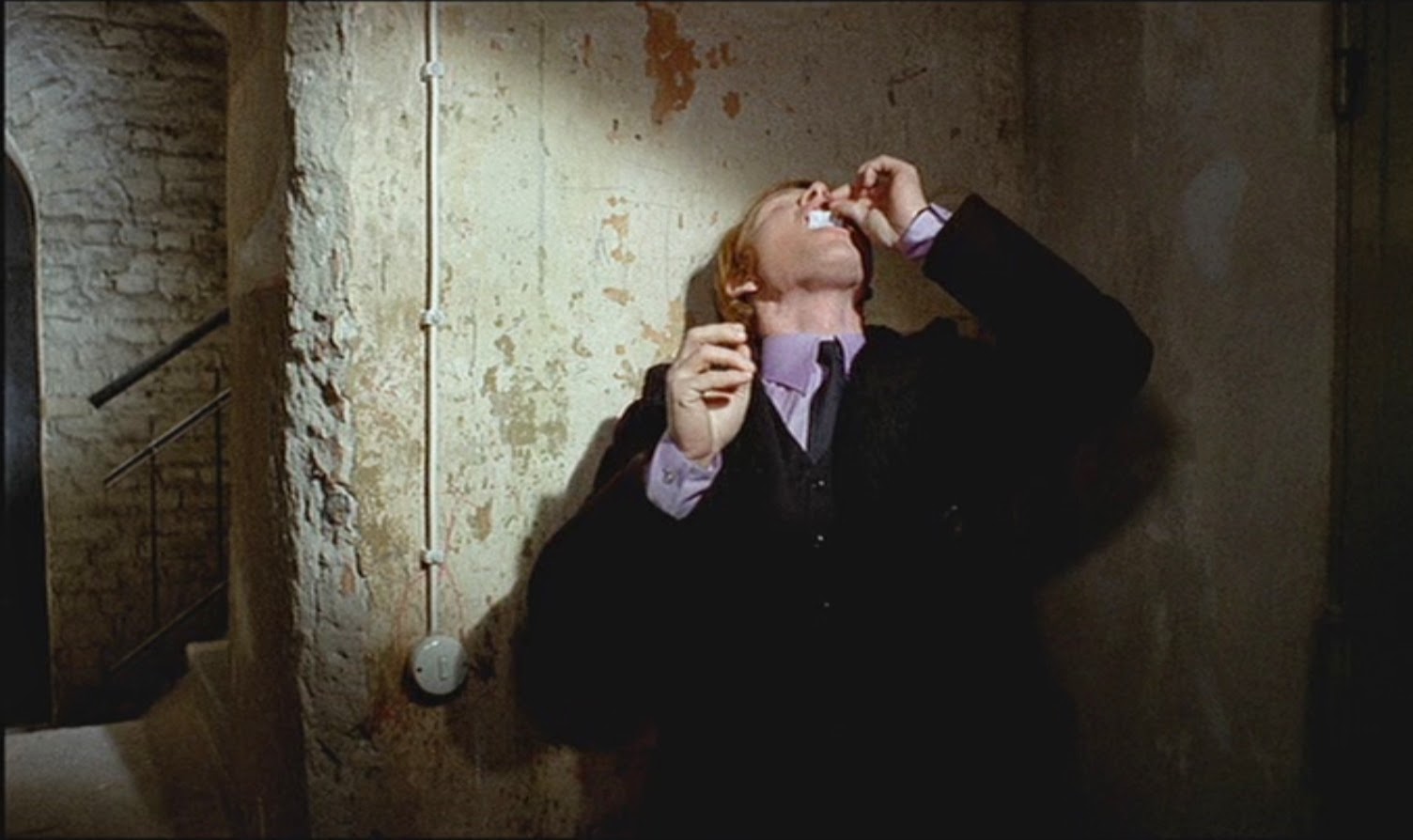
We get the spoiled, drug-addicted, ex-boyfriend of one of the dancers, whose mother—the Elisabeth Flickenschild analog mentioned above—forbids him any contact with the woman he loves. (And, unless I'm misunderstanding something, downs heroin out of little packets like he's inhaling Pixy Stix):
We get future SUSPIRIA cast member Rudolf Schündler in a largely forgettable role as an antiques dealer who is also helping the gang traffic its drugs:

The only refreshing suspect is the genuinely creepy ventriloquist, whose relationship with his humpty-dumpty headed dummy is maybe the most memorable thing about the whole movie. Certainly the most uncomfortable, with the high-pitched dialogue that passes between them and the tendency of the dummy to haltingly call the man “Daddy”. It's less interesting that he's set up as a blackmailer, an eavesdropper, and a peeping tom, esp. for how quickly he's killed off when these red herrings about him are introduced. It's more interesting what they do with him visually, including the nightmarish touch of having his killer don the head of his dummy in order to hide himself in the man's dressing room:


The fact that he is killed off so quickly (snuffing out his weirdness factor before it can really take hold in the film) reinforces the overall feeling of the film: That all of its elements are being given short shrift by the filmmakers. That all involved don't care too terribly much what the final filmed product turns out to be. That the Krimi has become tired enough that maybe it should, in good conscience, be discontinued, but box office makes it necessary for it to continue. (It's really not a fun watch for a bona fide Krimi-and-Giallo fan, tbh.) 
  • Really offensive caricature of the gay characters. Highly problematic is an understatement. As you can probably gather from the subtitles below, the bartender "Softy" (at right) is advising Sir Arthur (left) about a "new cooking recipe" he must try. Instead, it's played as a rude euphemism to describe the bartender's sexual orientation. His sexuality, without exception, is presented in the worst kind of stereotype—as a character, the filmmakers use him for no other purpose than as an excuse to deliver a series of cringe-inducing (and downright offensive) punchlines. Which is the first example of this in the Krimi that comes to mind, i.e., where the stereotypical, two-dimensionality of a character is so offensive it's hard to overlook. You might argue, in retrospect, that the endlessly employed role of "ingenue in distress" (esp. in the b&w Krimis) is a dated, sexist view of female characters who only exist to be saved by men. But even if that's true (sometimes it certainly is), I can't remember being made so uncomfortable by their portrayal as the bartender's here. In this way, the opening up of censorship made it possible for the film to be *more* offensive in its portrayal of a "deviant" lifestyle, making an explicit and awful joke out of what had only been implied, in these films, in the past.

Though characters like the homosexual detective in Argento's FOUR FLIES ON GREY VELVET aren't exactly progressive, they are light years ahead, in terms of characterization, of examples like this.
Alongside this is what feels like anachronistically dated sexism, in the relationship between Sir Arthur (Hubert von Meyerinck) and his secretary-slash-assistant Miss Finley (Ilse Pagé). He rests his hand on her backside as she bends over a pool table to line up a shot (and, of course, she's portrayed as enjoying it). She goes to nightclubs with him and whines when he won't dance with her, despite the fact that it makes no sense (on any level) that she would be interested in him. He tickles her grinning chin, after she says that the knifethrower's knives flying at her make her think of her octogenarian boss' advances. (This more old-fashioned-feeling sexism on Sir Arthur's part resurfaces as full-on dirty-old-man-ness in THE GORILLA OF SOHO. There, he goes to a sex club where nude women hang off the bulging biceps of a bodybuilder and picks out women to first photograph, then take home to bed. Here he's annoying; there he's gross ... and, in either case, his characterization serves no purpose but to put off the viewer from any engagement with the story at hand:
Apparently the New Scotland Yard is full of doddering old cads who spend their time pawing at secretaries who are young enough to be their granddaughters.
At times, it really feels like they're not acting in a Krimi, but a Benny Hill skit.
Generally, these color Krimis feel like they are trying too hard, even as they have no idea (or real understanding of) what it is they’re trying. Definitely a bummer for me. It makes me re-evaluate the earlier pictures in the cycle (tends to make me want to rate them more highly), and makes me treasure the handful of black-and-white pics I still haven’t been able to see. Even at his worst, I’ll take Eddi Arent’s mugging over these wrong-footed, wrong-headed attempts to make the color entries “swing”. (At least Arent occasionally manages to have genuine charm.)

ps. And, again, I should stress that some of the color films do work in the transition, in their updating. I mentioned DOUBLE FACE above. WHAT HAVE YOU DONE TO SOLANGE? and SEVEN BLOOD-STAINED ORCHIDS belong in that category too, though that may have more to do with their success as Gialli than anything else. And, to a lesser extent, I'd probably also add ANGELS OF TERROR (whose write-up is on the horizon).


Leonard Jacobs
October, 2014


[SHOW NOTES]
VERSION WATCHED: The German DVD release in Vol. 8 of the Edgar Wallace Box Sets. | LANGUAGE: German language with English subs | DIRECTOR: Alfred Vohrer | WRITER(S): Paul Hengge, Ladislas Fodor, Edgar Wallace | MUSIC: Peter Thomas | CINEMATOGRAPHER: Karl Löb  | CAST: Horst Tappert (Inspector Perkins); Karin Hübner (Yvonne); Hubert von Meyerinck (Sir Arthur); Stefan Behrens (Sgt. Pepper); Fritz Wepper (Bruce); Ilse Pagé (Miss Finley); Christiane Krüger (Linda); Ewa Strömberg (Doris, as Eva Strömberg); Marlies Dräger (Leslie, as Marlies Draeger); Heidrun Hankammer (Leila); Friedel Schuster (Lady Sheringham); Rudolf Schündler (Nuthacher); Maria Litto (Liz); Jan Hendriks (Rubiro); Iris Berben (Ann); Harry Riebauer (Bob)