Showing posts with label Werner Peters. Show all posts

9.25.2014

#006 KRIMI POCKET REVIEW [THE SECRET OF THE BLACK WIDOW aka DAS GEHEIMNIS DER SCHWARZEN WITWE (1963)]


[Note: This is the eighth post in a continuing series discussing and analyzing our favorite Krimis and Gialli (some of the reviews started as rough drafts on my Letterboxd account). As with every post on this site, SPOILERS SHOULD BE EXPECTED.]


My Krimi Rating: ★★
Subcategory (if any): 
     i.
Inheritance Scheme Krimi
     ii.
Ingénue in Distress Krimi

     iii.  Arent-as-Comedy-Routine
     iv.  Kinski-as-Grotesque
 Who Portrays the Detective (amateur or official): 
     
O.W. Fischer (amateur); Klaus Kinski (official) 
Who's the Ingénue: 
    
Karin Dor

 In My Krimi Top 20 (Y/N): No (Letterboxd link) 


1963's SECRET OF THE BLACK WIDOW plays as a weird (but ultimately underwhelming) mish-mash of canonical and non-canonical Krimi-isms. Klaus Kinski is in the cast, though in a bowler-hatted, buttoned-up, not-very-mysterious mystery man persona that feels decidedly un-Kinski-ish.

Low-key Kinski that never really pays dividends. There are shots like this that almost make Kinski's character feel sinister, in a men-in-black, secret agent sort of way. But his performance, and the film's explanation of his character, fail to reinforce this.

Karin Dor is here, in a dual role of both the series-requisite "ingenue in distress" and as a woman seeking revenge on a wealthy pack of jackals who may or may not have covered up the murder of her father on a far-flung archeological expedition. (It is this part of the plot that feels like it comes from one of Edgar Wallace's many non-Krimi stories; though this is maybe because it's not written by Wallace at all, but exists as one of the Louis Weinert-Wilton-based attempts to compete with the official Rialto series. It is for this reason also, I'd have to assume, that the avant-pop-art-psychotronic sensibility of the best "official" Krimis is all but missing. This is *in spite of* a murder weapon that somehow shoots both [toy?] black widows and bullets out of the same, unmodified barrel.)


Lots of light and shadow when it comes to Karin Dor in this movie.

Werner Peters and Eddi Arent also show up, though in roles that rank among their most forgettable. Peters is a harried moneyman whose newspaper empire has been built on the dead back of Dor's father (or so she believes). Arent is a smarmy newspaper archivist who has somehow memorized every article from every newspaper for decades, and is willing to sell this information for small favors from our lead Joachim Fuchsberger-analogue O.W. Fischer (more on him in a minute).


Our Arent librarian.

What I will say is there's a moment that feels both teleported in from the genre future (from another Krimi, ROOM 13, made in '64), and that reminded me a whole helluva lot of Lynch.

Dor is taken to a nightclub by someone who wants her to hear the performance of a popular song (about black widows o'course). The stated plot reason for this is because she's suspected of being the titular "Black Widow" killer (or at least the one sending out threatening notes in the killer's name), and being forced to listen to the song in the presence of her accuser is, I guess, supposed to get her to crack and confess everything.

The performance's actual screen time feels like it's taking up more than it warrants. (The song itself is repetitive, which probably contributes to this.) Dor is made to watch the song, wearing a look that is somewhere between "transfixed" and "uncomfortable". (Which is the connection to ROOM 13 and all those scenes with a profoundly transfixed, profoundly troubled Dor before the painted altar of her dead mother.)

What feels borderline Lynchian, though, occurs in the middle of the singing: The singer (who is shot in a way to suggest that she is staring directly, throwing loaded looks the entire time, at Dor) is shown first in the reflection of a series of mirrors, then in full spotlight, singing on the stage. Inexplicably, as the song progresses, all the lights in the night club are cut, leaving the singer in a shimmering blackness as she continues to sing her song like a mantra (her voice sounding almost artificially slowed, like playing from a degraded record that's not quite spinning at speed).


In the darkness she raises the palm of her hand and offers it to the audience in a kind of "stop" motion. When she does this, her hand is suddenly litthe only lit thing in the room, throwing her pronounced fingernails and knuckles into high-relief on screen. For however many seconds, we are staring at her blazing, lit-up hand like some kind of sigil. Some kind of post-hypnotic trigger meant probably not for the audience, but to specifically unlock Dor's mind.


Then we get a series of increasingly close shots of the two women's faces, a cutting back and forth between Dor and the singer, the singer looking more intent (and melancholy), Dor looking more uncomfortable. There is a portion of this sequence where the camera holds on the closeup of the singer, as she is speaking-singing the repetition of lyrics almost like an incantation.


Suddenly back in the light, without her beacon hand.


The Lynch-like sequence in question. Shades of Isabella Rossellini singing the club down in BLUE VELVET, and the woman singing in the first(?) season late at night in the local bar on TWIN PEAKS tv.

You half expect the film to go off into some kind of reverie, some kind of time-slip, some kind of TWIN PEAKS-like nightmare use of image and sound to reflect, redress, recalibrate Dor's mind. (Because I've been doing a bunch of reading about it lately, it also immediately felt like a "trigger event" in some kind of government mind-control story. Or the more likely "Art as Trigger" device that shows up in other Krimis and Gialli [again, see the ROOM 13 writeup for some context on this].)

As the song ends, the camera pans from her face to an enormous, blinding spotlight.
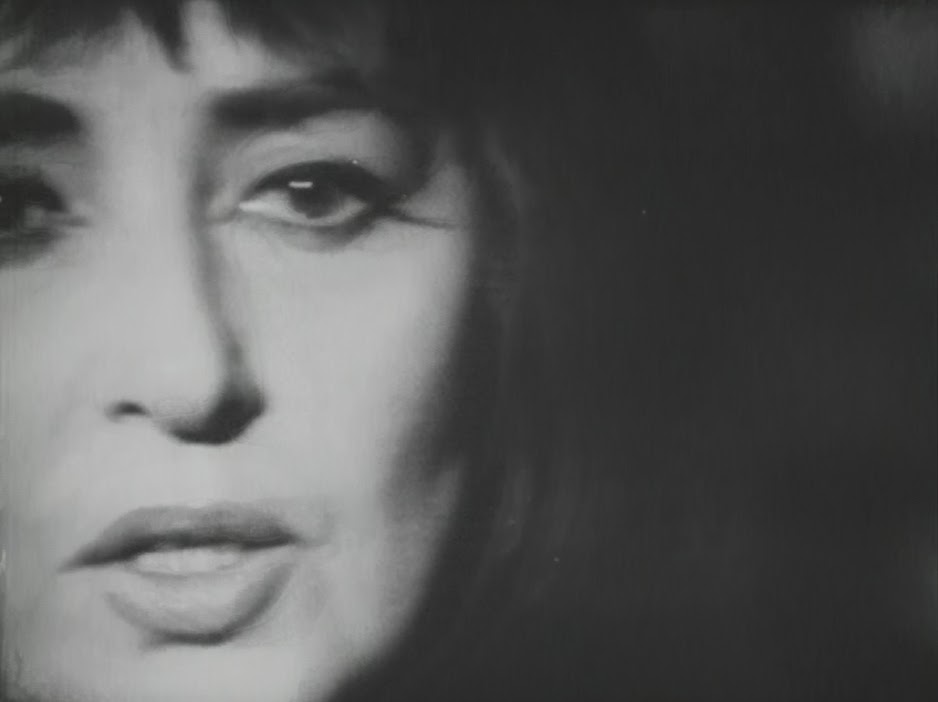


Alas, the rest of the movie fails to really bear out any of these associations. The proverbial lights come back up, and the paint-by-numbers plot reasserts itself to the point that any such appearance of dream-logic or soul-mystery is quickly dissolved. And then there's a bunch more stuff about gambling debts, stolen treasure, blah blah blah. Esp. a letdown because Franz Josef Gottlieb has done sublime work elsewhere. :/
 

ps. Ah, I forgot to get back to O.W. Fischer. He's the lead reporter/lead amateur sleuth in the mix. Beyond looking vaguely like Fuchsberger's less-handsome relation, he's a real dud here. He begins the movie as a complete and unapologetic lush, showing up to crime scenes with nip in hand, spouting witticisms in the most ridiculously theatrical affectation I've heard in years. (It's true that that may be an English dub problem [I had no access to the original German; but as it's clear his physical performance is meant to reinforce this affectation, I have to think the German wouldn't make it any less grating. More than anything, his performance seems intent on making us see his "hero" character as nothing more or less than a buffoon.])

(And there's a running gag about him being constantly sick, constantly sneezing, constantly swabbing at his running nose. Why does this exist in the movie? Only to annoy the audience it seems.) 


O.W. Fischer, in all his fake-beard, pipe-wagging glory.
He also spends the first third or so of the movie in a scraggly, highly fake beard. A beard that makes no sense in relation to his character. A beard that he promises to "shave" after he meets Dor, because (of course) within seconds of meeting her he has decided to treat her like an object that he will soon possess. Putting all that mess aside, he is the very definition of bland in a role that feels like an imitation of an imitation (of an imitation). Meh.

And on the list.

Leonard Jacobs
September, 2014

[SHOW NOTES]
VERSION WATCHED: The dreadful Televista DVD | LANGUAGE: English dub | DIRECTOR: Franz Josef (F.J.) Gottlieb  | WRITER(S): Alexandra Becker, Rolf Becker, José María Otero, Louis Weinert-Wilton | MUSIC: Martin Böttcher, Antonio Pérez Olea | CINEMATOGRAPHER: Godofredo Pacheco  | CAST: O.W. Fischer (Wellby); Karin Dor (Clarisse); Eddi Arent (Fish); Klaus Kinski (Boyd); Werner Peters (Mr. Shor); Doris Kirchner (Mrs. Shor); Claude Farell (Mrs. Ayke); Gabriel Llopart (Selwood); Fernando Sancho (Slim); José María Caffarel (Cartwright); Antonio Casas (Bronsfield); Belina (Sängerin); George Rigaud (uncredited)

9.13.2014

#003 KRIMI POCKET REVIEW [THE BLACK ABBOT aka EDGAR WALLACE: DER SCHWARZE ABT (1963)]


[Note: This is the fifth post in a continuing series discussing and analyzing our favorite Krimis and Gialli (some of the reviews started as rough drafts on my Letterboxd account). As with every post on this site, SPOILERS SHOULD BE EXPECTED.]


My Krimi Rating: ★★★½ (out of 5★) 
Subcategory (if any): 
     i. Masked Monk Krimi

     ii. Inheritance Scheme Krimi
     iii. Arent-as-Comedy-Routine Krimi

     iv. Kinski-as-Grotesque Krimi  

     v. Ingénue-in-Distress Krimi
     vi. Old Dark House Krimi 
Who Portrays the Detective (amateur or official): 
     Joachim Fuchsberger (amateur); Eddi Arent (official); Charles Regnier (official)
Who's the Ingénue: 
     Grit Boettcher

 In My Krimi Top 20 (Y/N): Yes (Letterboxd link)


Not unlike THE STRANGE COUNTESS, this Krimi starts with a strong, visually interesting prologue, suffers from a middle that feels belabored and all over the place (esp. in terms of the unspooling of the plot), and features a final 10 or 15 minutes that becomes exponentially more interesting than the rest of the movie combined. This interest (again, mirroring the Gloria Swanson-like mugging and frenzied whispering of the Countess) is located solely in the performance of the moneyed, “mad” character who finally reveals the extent of his madness. The meltdown of Lord Chelford (Dieter Borsche) here becomes the climax of the film. 

[1. OPENING STRONG] 
The interest here lies in an in media res introduction of a plot concerning an ancient family treasure, an ancient family curse, and the black-masked Abbot whose piercing eyes and peaked head haunt the whole affair like a ghost. Some characters scoff at the existence of the treasure; others swear by it—get driven mad by it—or get dispatched by the Abbot who puts an end to their grasping, conniving plans.


The prologue opens with an unnamed man stalking around the ruins of a massive estate. His sneaking in the night is being watched by the Abbot, who proceeds to knife the man in the back. That murder segues to the by-now-familiar gunshot sound effects that throw up 12 bloody splotches on the screen (one for every letter of Wallace's name). And then on to the credits sequence.

Despite coming just a year before his far superior PHANTOM OF SOHO, this effort by director F.J. Gottlieb feels exponentially less sophisticated, less ahead of its time, less forward-looking (in terms of anticipating not only what the Krimi genre would do, but what would come to be hallmarks of both the Giallo and Slasher genres as well).


The images that occur once the garishly colored credits finish establish another “character” in the film, the Chelford Estate. It is *the* key location on this film's “mapback,” with most (if not all) of the characters drifting into its orbit at some point or another (including several of them being murdered on its grounds).
 
One of the many stylistic flourishes that the Krimis are known for are their so-called “novelty shots”characters or items that are shot through unusual frames. The most famous is probably the shot of the man eating a carrot in DEAD EYES OF LONDONshot from *inside* his mouth. Here, the technique is much less utilized, and only shows up in muted versions like the one here, filming Borsche's return home through the flames of the fireplace.

[2. A MIDDLE THAT FALLS DOWN, DRIFTS, WANDERS AIMLESSLY ABOUT] 
Diluted is really the word here. Also repetitive, and a bit confused:

One of one-too-many red herrings, getting what it deserves.
  • At least three different people are revealed to be the Abbot (except, of course, they aren’t); these revelations totally take the air out of the menace, the popped eyes and cowl, the black stalking silhouette of a mystery man who is presented as maybe being a supernatural being, even one who is so powerful, none of the characters will be able to stand up under his baleful gaze. 


Familiar face Werner Peters reveals the urges that drive his attempts at blackmail. He is, as we often find him in the Krimi, a despicable stain of a man.
  • Three or four different characters hatch (and fail at) conflicting blackmail schemes. Some of these blackmail plans fail literally within minutes of being introduced in the movie, which makes them seem not only extraneous, but blaringly unnecessary red herrings. Also esp. tedious are the scenes of various characters trying to find the underground entrance to the cache of family treasure. The scenes open atmospherically enough...


... but they fall down at maintaining that atmosphere far too fast.

Eddi being Eddi.
And again.
  • Eddi Arent’s high-jinks, which feel, at the beginning of the movie, like they’ll be relatively toned down, instead become increasingly obnoxious as the movie goes on. Increasingly pratfall-faced. Increasingly counterproductive to the movie’s otherwise mysterious tone. (This is esp. true when he, once again, breaks the fourth wall for a goof, as the last shot of the movie.)


When Borsche isn't being kept off-stage, he thankfully becomes the center of everything. Whether it's gunning down his mother (immediate aftermath pictured in the top image), or groggily sleepwalking through his own mansion, under the influence of drugs. (Also, when I pulled these screencaps, I realized that he is repeatedly lit in a way that throws up the shadow of what could almost be exaggerated, "mad" eyebrows on his face. A subtle but effective visual flourish.)
  •  Dieter Borsche's Lord Chelford is sidetracked on account of repeatedly being drugged by his doctor (all to "help him sleep"). This clears the stage for too many of the supporting characters who don't, ultimately, leave much of a mark. 

 
  • And poor Klaus Kinski. After his mostly forgettable cameo in THE DOOR WITH SEVEN LOCKS, this is maybe his next, least-memorable appearance as a series villain. He plays Thomas Fortuna, the always lurking, “stunningly well-informed” ex-convict butler working for Lord Chelford. In his limited screen time, Kinski tries to blackmail Joachim Fuchsberger (Chelford's confidant-slash-administrator) and keeps feeding secret information to Peters' character. He is murdered while masquerading as the Abbot; all in all, his screen time lacks any of his patented, nuanced, unfiltered W-E-I-R-D. For the movie, his inclusion is a miss. 

Speaking of misses ... for many, Joachim Fuchsberger is *the* face of the Krimi. And yet, I could easily write this entire review without mentioning him. Whether this is down to him, for once, not being the investigative lead in the film, or because his grimacing, always annoyed turn as Chelford's administrator gives him one of his most morally dubious characters in the series, I'm not sure. Combined with a muddied and forgettable “forbidden love interest” subplot for his character, it makes this one of his least memorable outings. My main memory of him in the movie are repeated shots of him looking annoyed while Kinski's character tries to chisel some blackmail out of him. All the more reason to argue that this is Dieter Borsche's film, even if that only becomes clear in the climax.

[3. ENDING PSYCHOTRONIC AND STRONG]
Lord Chelford, like the aforementioned Strange Countess, is the one who finally reveals himself both to be utterly insane, and the single best thing about the movie.


Lord Chelford, getting increasingly lost in the paranoia of his own head.
His final trigger is seeing the apparition of his dead mother in the Abbey ruins (where the treasure that obsesses him is supposedly buried). Not only does her appearance elicit a psychotic bodily reaction in him—his face seizing up, emitting a  deranged and frightened shriek—when she tries to console him, he brandishes a revolver and guns her down on the spot (he later defends the murder by claiming that the spirit of the Abbot had been supernaturally merged with his mother's, to create a kind of "Lady Black Abbot" haunting him and his land).

This mental break sets in motion the most sublime section of the movie. He is all at once a ball of contorted, clashing emotions: He is a petulant, tantrum-prone man-child. A possessive but aloof plantonic lover. A death- and treasure-obsessed old man, mortally afraid that he will be the last of his line. A real insane case, with the last 10 minutes or so giving us his various pathological states, rapid-fire like:


Six stages of crazy. Borsche is an interesting case in these Krimis. I first became aware of him as the white-contact-wearing, reptilian-slimy priest in DEAD EYES OF LONDON, he who brandishes, in the climax, one of the biggest flamethrowers I’ve ever seen and attempts to fry Joachim Fuchsberger to death, deep in the bowels of London. Next I saw him as the ever-reliable, ever-capable, incredibly self-contained Chief Inspector Patton in PHANTOM OF SOHO. He's so self-contained, I didn't realize it was the same actor until the second time I sat through the movie. Even though the number of his appearances don’t begin to approach other genre regulars—Fuchsberger, Arent, Kinski, Dor—I’m tempted to say that he displays the most (and most convincing) range.
Would that Borsche could've held sway over more of the film. Would definitely make the final product rate more highly. Still, added to the middle of the Letterboxd list

Leonard Jacobs
September, 2014
[SHOW NOTES]
VERSION WATCHED: The German DVD release offered in Vol. 4 of the Edgar Wallace Box Sets. | LANGUAGE: Whenever possible, I watch these with the German soundtrack and English subs, which I did here. I rewatched portions with the English sountrack (while taking caps) and found it to be distractingly bad. | DIRECTOR: Franz Joseph Gottlieb | WRITER(S): Edgar Wallace, Johannes Kai, Franz Joseph Gottlieb | MUSIC: Martin Böttcher | CAST: Joachim Fuchsberger (Dick Alford); Grit Boettcher (Leslie Gine); Dieter Borsche (Lord Harry Chelford); Charles Regnier (Detective Puddler); Eva Ingeborg Scholz (Mary Wenner); Werner Peters (Fabian Gilder); Alice Treff (Lady Chelford); Harry Wüstenhagen (Arthur Gine); Friedrich Schoenfelder (Dr. Loxon); Eddi Arent (Horatio W. Smith); Klaus Kinski (Thomas Fortuna); Kurd Pieritz (Smooth)